
Don’t Buy an AV Receiver Until You Read This: The Truth About AVR Power Ratings in India

By Deepak Saxena
Founder, AV Consultants | 17 Years of Engineering Private Cinemas Across India
The luxury residential landscape in India has undergone a massive transformation over the past decade. Today, sophisticated homeowners across Chandigarh, Punjab, Haryana , Delhi NCR, Mumbai, and Bangalore are willingly investing ₹10 Lakh, ₹20 Lakh, ₹30 lakh or even ₹50 Lakh to build bespoke private home theaters. They choose ultra-premium, world-class loudspeakers from iconic manufacturers like KEF, Pylon, Klipsch, Golden Ear , Focal, Monitor Audio, and Bowers & Wilkins. They spend weeks coordinating with interior architects, selecting fine acoustic fabrics, sourcing high-end 4K laser projectors, and installing plush motorized recliners. Yet, after 17 years in the trenches designing, engineering, and calibrating high-performance private cinemas, I see the exact same heartbreaking engineering mistake happen almost every single week. Homeowners allocate a massive portion of their budget to everything that is highly visible, but treat the core electronic engine—the AV Receiver (AVR)—as a cheap, secondary afterthought.
They completely decouple the physical physics of their speakers from the electronics driving them, often leaving the final product selection to consumer electronics “box movers.” These high-volume retail salespeople rarely possess true engineering competence. Instead, they push specific gear based on corporate sales incentives, monthly retail quotas, and highly inflated factory brochures. The tragic outcome is a system where a major percentage of the client’s financial investment is functionally choked. The expensive, meticulously selected loudspeakers end up starved of current, trapped behind a bottleneck, and completely incapable of delivering the raw, visceral, and emotionally engaging cinematic performance the homeowner actually paid for.
The Great Indian Home Cinema Bottleneck
To contextualize this mistake, imagine buying a multi-crore Italian supercar with precision handling, but dropping the tiny engine of an entry-level city hatchback right under the carbon-fiber hood. On the surface, it looks absolutely magnificent sitting in your driveway. Your friends and family will admire the sleek lines, the premium paint finish, and the luxury interior upholstery. But the precise moment you pull onto an open highway, step firmly on the gas pedal, and expect a breathtaking rush of power, the painful illusion instantly shatters. The car struggles, the engine strains at high RPMs, and the vehicle completely fails to deliver the high-performance experience it promised.
This is exactly what occurs when premium, electrically demanding architectural or tower loudspeakers are paired with an underpowered, entry-level, mass-market receiver selected solely because of a flashy marketing sticker affixed to its front panel. Almost every misguided homeowner who reaches out to our engineering team at AV Consultants for a rescue calibration tells me the exact same story: “Sir, the retail salesman at the showroom explicitly guaranteed me that this receiver delivers 150 Watts per channel. He assured me it has more than enough power to blast my entire room.” Let’s bypass the retail sales talk and be completely direct: the immutable laws of audio engineering do not care about retail sales targets. The bold numbers printed on a glossy consumer brochure are carefully constructed marketing metrics designed specifically to move boxes off retail shelves. They are almost never an accurate reflection of how that amplifier circuit will actually behave when a complex, multi-channel movie soundtrack aggressively hits your room.
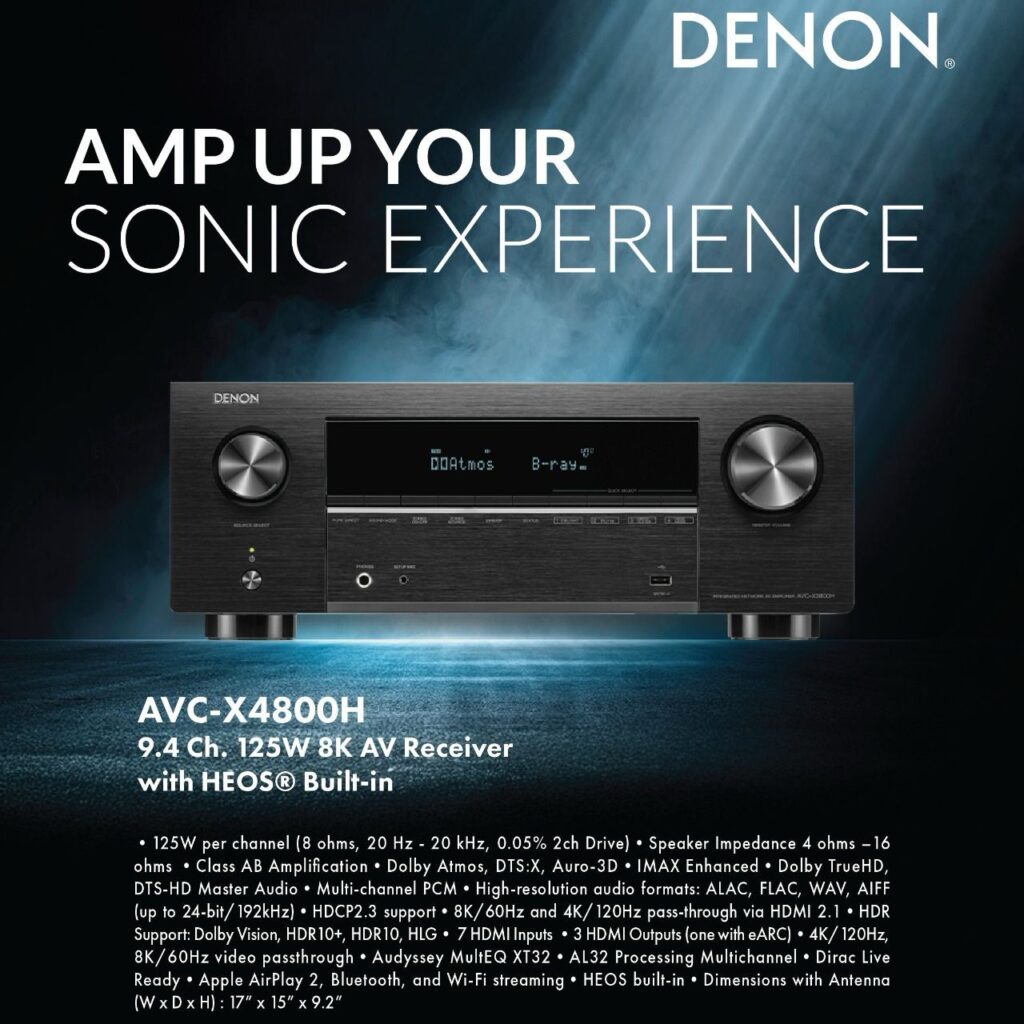
Decoding the Anatomy of a Marketing Specification
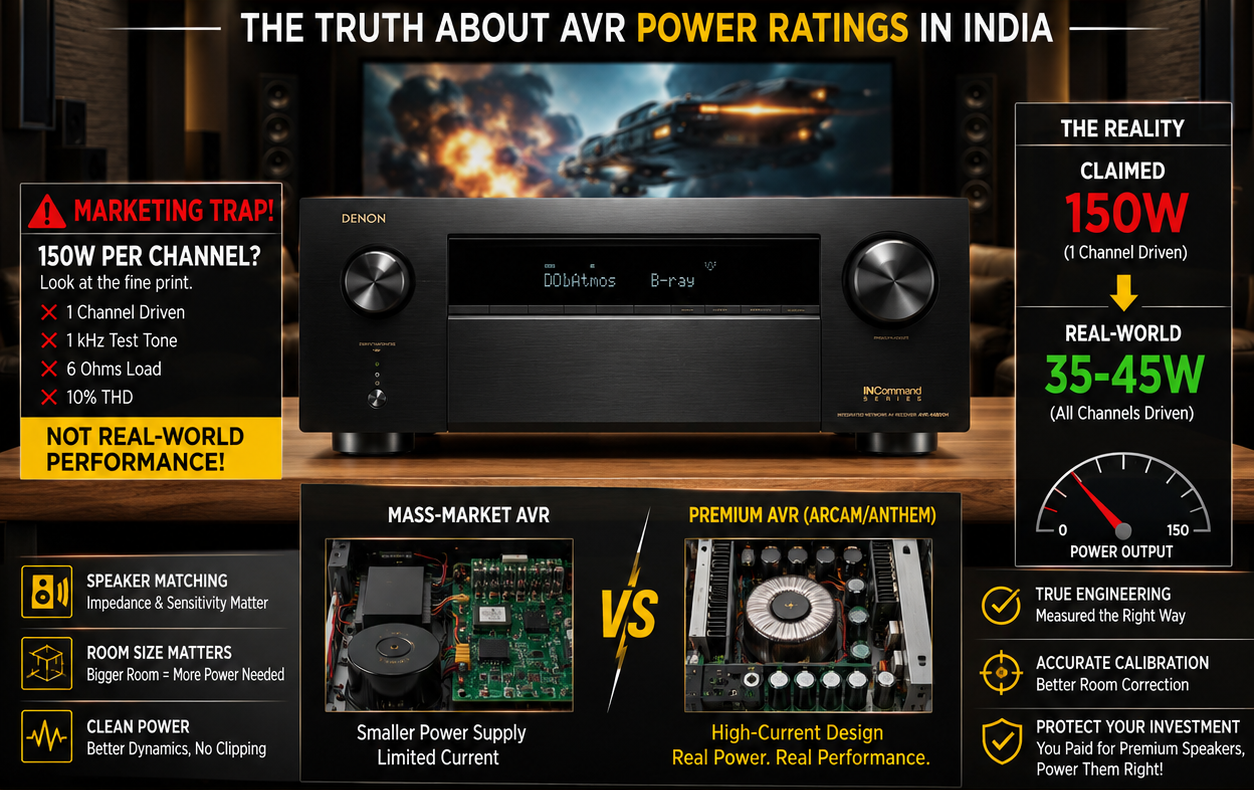
To protect your financial investment, you must learn to look past the front-panel stickers and analyze the fine print hidden deep within the manufacturer’s technical specification sheets. When a mass-market consumer brand claims that their AV receiver delivers 150 watts to 200 watts per channel, you must understand that this mathematical measurement was achieved under highly artificial, unrepresentative laboratory conditions. Manufacturers routinely manipulate four distinct testing variables to artificially inflate their published wattage figures:
- One Channel Driven: The factory testing engineers power exactly one single amplifier channel inside the machine. The remaining seven, nine, or eleven amplifier channels are left completely dark, drawing absolutely zero electrical current from the internal power supply.
- A Static 1 kHz Test Tone: Instead of forcing the amplifier to reproduce a demanding, complex, and full-bandwidth audio signal, they pump a single, ultra-easy-to-reproduce midrange frequency through the internal circuitry.
- An Easy 6-Ohm Load: They test the amplifier’s output against a lower electrical resistance than standard high-performance residential loudspeakers. Lowering the resistance artificially spikes the final wattage calculation on paper.
- Elevated Distortion Thresholds: They allow the audio signal to distort heavily, pushing the measurement limits up to 1% to 10% distortion (Total Harmonic Distortion).
In the real world of cinema calibration, an audio signal running at 10% THD sounds like a harsh, unlistenable, screeching mess. More importantly, that level of heavy distortion creates massive clipped square waves that will rapidly overheat and physically destroy your speaker’s delicate, expensive high-frequency tweeters. While these heavily manipulated measurements are technically legitimate under relaxed industry testing standards, they bear absolutely zero relevance to what actually happens when you turn off the lights in your private cinema and play a modern, dynamic Dolby Atmos or DTS:X soundtrack.
Home Theater Budget Planner in India .
| Component | Allocation |
|---|---|
| Speakers & Subs | 50% |
| AVR & Amps | 20% |
| Acoustics | 15% |
| Display | 10% |
| Seating & Automation | 5% |
What Happens During Real Movie Playback?
A real, modern blockbuster movie soundtrack does not send a polite, isolated, static midrange tone through one single speaker channel at a time. Consider a massive action sequence: a bridge collapses, an aerial dogfight rages overhead, an explosion rocks the floor, and a dense orchestral score swells across the room. In that exact millisecond, your system faces an immense multi-channel electrical demand:
- The Front Left and Right speakers demand massive, instantaneous energy to reproduce the scale and dynamics of a sweeping orchestral score—frequently requiring dedicated external power amplifiers from high-current brands like Arcam, Anthem, or Emotiva to truly unlock their performance.
- The Center Channel strains under heavy load to keep actor dialogue crystal clear, sharp, and intelligible amidst the onscreen chaos.
- The Side and Rear Surrounds push high-frequency localized sound effects across the horizontal plane to track fast onscreen movement.
- The Ceiling Height Channels work overtime to generate a seamless, three-dimensional Dolby Atmos overhead immersion bubble.
Every single one of these distinct audio channels cries out for massive electrical current at the exact same fraction of a second. Because standard mass-market AV receivers utilize a single, shared, cost-cut internal power supply to feed every single amplifier channel inside the chassis, the available power pool collapses instantaneously under this type of heavy multi-channel load. A receiver marketed proudly to Indian buyers as a 150 watts powerhouse will frequently drop down to a meager 40 watts to 60 watts per channel when All Channels Are Driven (ACD) simultaneously across the full audible spectrum (20Hz to 20KHz).
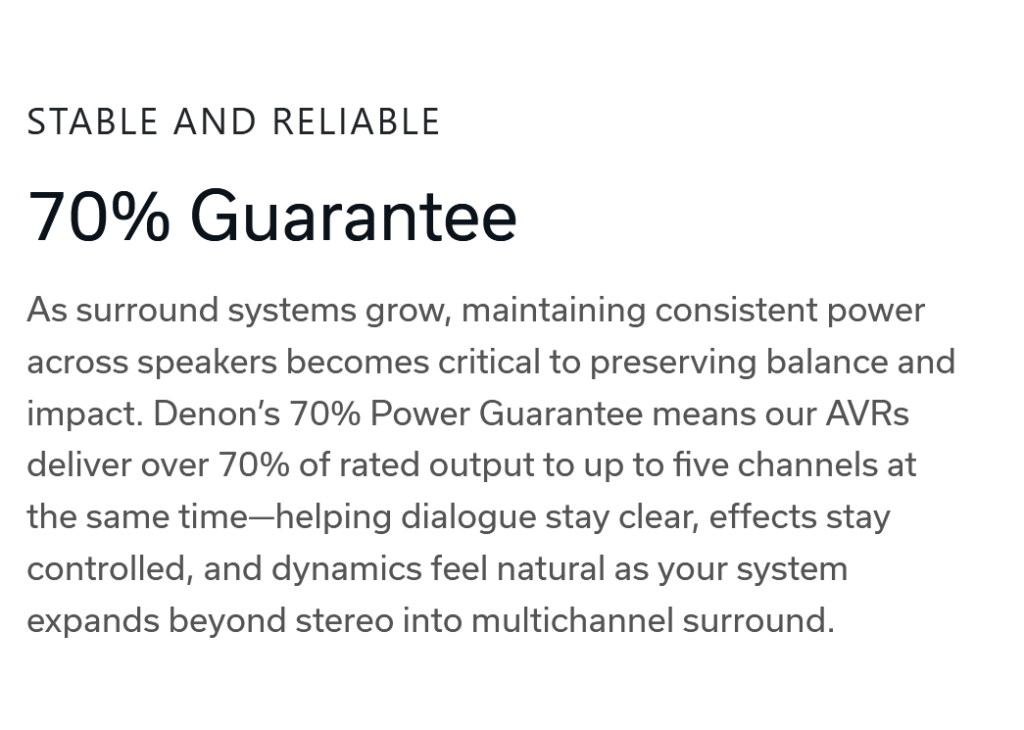
When your high-end, premium loudspeakers are starved of current during these sudden, dynamic cinematic peaks, your system runs directly into severe engineering limitations. The first consequence is severe Acoustic Compression. The soundstage flattens out entirely, loses its three-dimensional depth, and completely fails to deliver the physical, visceral impact the film director intended. The second, more dangerous consequence is Amplifier Clipping. The power supply physically runs out of voltage, causing the amplifier to flatten the tops and bottoms of the audio waveforms into sharp, clipped edges. This introduces harsh harmonic distortion that causes immediate listener fatigue, subconsciously forcing you to reach for the remote control to turn the volume down during the most exciting action scenes of the movie.
The Physics of Room Volume and Speaker Sensitivity
A qualified acoustic engineer will never recommend an electronics package without first conducting a deep analysis of your architectural blueprints and your speaker profiles. Yet, standard box movers across India almost never ask the two most critical questions in audio engineering: What is the cubic volume of the room? and What is the exact sensitivity rating of the loudspeakers?
1. Cubic Volume and Room Scale
Your home cinema room is not just a flat floor plan; it is a physical, three-dimensional volume of air that your amplifiers and speakers must physically pressurize to create impactful sound.
- Small Rooms (Up to 150 sq. ft.): These intimate spaces require a relatively low amount of acoustic energy to hit satisfying volume levels. A high-quality, feature-rich mass-market AVR can perform beautifully here because it isn’t being pushed to its absolute thermal or electrical limits.
- Medium Rooms (150 to 250 sq. ft.): As the cubic volume of air expands, the electrical power demand rises exponentially. You require higher-tier electronics with significantly larger internal power reservoirs to maintain effortless control during intense movie scenes.
- Large Dedicated Cinemas (250+ sq. ft.): These large spaces require an immense amount of uninterrupted acoustic energy to achieve true cinematic reference playback levels ( 85db nominal with 105db dynamic peaks). If you place a standard mass-market receiver in a room of this scale, you are forcing its internal components to run permanently at maximum capacity, guaranteeing muddy sound, compressed dynamics, and systemic thermal strain.
2. Speaker Sensitivity: The Great Multiplier
Speaker sensitivity dictates exactly how efficiently a loudspeaker converts raw electrical wattage into acoustic volume. It is calculated by feeding exactly 1 Watt of power into a speaker and measuring the sound pressure level (SPL) from exactly 1 meter away.
- High-Sensitivity Speakers (90 db to 95db ): Often found in specialized commercial cinema-line gear or high-efficiency horn-loaded designs. Because they are exceptionally efficient at converting electricity into sound, they require very little power to achieve high volumes, placing minimal stress on your receiver’s power supply. ( Dirven by Marantz & Denon effortlessly )
- Low-Sensitivity Speakers (84 db to 86db): This category includes many of the world’s most premium, high-end audiophile tower speakers and architectural in-wall models. They are notoriously inefficient. To achieve the exact same acoustic volume that an efficient speaker produces with just 10 Watts, a low-sensitivity speaker might demand 40, 50, or even 100 Watts of completely clean, uncompromised power. If your AVR lacks deep current reserves, these premium speakers will ruthlessly expose its limitations within seconds of an action scene starting.( Dirven by Anthem & Arcam effortlessly )
3. The Lie of the “8-Ohm Nominal” Specification
This is one of the most misunderstood and dangerous areas of home cinema system matching. A speaker’s glossy brochure might proudly label it as an 8ohms nominal” load, leading unsuspecting buyers to believe it is incredibly easy to drive. In reality, a speaker’s electrical impedance is not a fixed, straight line; it changes continuously depending on the specific audio frequency it is trying to reproduce at any given millisecond.
When a high-end tower speaker attempts to output deep, heavy, fast-moving low-frequency bass notes, its electrical impedance will frequently dip down drastically to 4 ohms to 3 ohms, or occasionally even lower. Mathematically, when electrical impedance drops, the speaker demands double or triple the amount of continuous electrical current from the amplifier to maintain the same volume. If a mass-market AVR attempts to force current into a severe 3 ohms impedance dip during a massive onscreen explosion, its internal output transistors will overheat rapidly. This causes distortion to spike instantly, or it triggers the receiver’s built-in protection circuits, completely shutting down the machine mid-movie to prevent a catastrophic internal thermal fire.
Mass-Market Features vs. Premium Audiophile Engineering
To make an educated, rational purchase in the Indian home theater market, you must understand exactly what you are paying for when analyzing the two primary tiers of AV electronics.
The Mass-Market Big Four: Denon, Marantz, Yamaha, Onkyo
These four massive brands are the undisputed kings of global consumer features, slick user interfaces, and modern smart-home lifestyle integration. For a standard multi-purpose living room layout or a highly efficient architectural speaker package, the higher-tier models within these brands—such as the Denon X-Series (e.g., X3800H, X4800H) or the Marantz Cinema Series (e.g., Cinema 40, Cinema 50)—are outstanding, highly capable machines.
- Where They Excel: They offer flawless, high-bandwidth HDMI 2.1 switching, cutting-edge next-gen gaming support (4k 120Hz VRR, ALLM, QFT), effortless wireless multi-room streaming connectivity (HEOS, MusicCast, Play-Fi), and superb onboard digital decoding for all standard immersive audio formats.
- Where They Cut Corners: To hit a highly competitive mass-market retail price point while simultaneously cramming 9 or 11 channels of independent amplification into a single consumer-sized box, manufacturers must make sharp compromises on the underlying power infrastructure. They use smaller frame transformers, downsized power storage capacitors, and lightweight, stamped internal aluminum cooling sheets. They simply do not possess the heavy, high-current power reserves needed to command complex, low-impedance speaker loads in a large, dedicated private cinema environment.
The Premium Engineering Platforms: Arcam & Anthem
The moment you step into the world of high-end, heavy-duty private cinemas using elite speaker packages, you must step away from consumer-grade features and transition toward high-current luxury engineering. Premium brands like Arcam and Anthem are designed strictly for performance-first purists and professional cinema calibrators.
- Uncompromised Power Delivery: When Arcam or Anthem states an amplifier channel outputs 100 watts , that rating means true, sustained power with all channels driven simultaneously, across the full frequency spectrum (20 Hz} – 20 kHz), at near-zero distortion. They don’t play specification games.
- Advanced Amplifier Topologies: Arcam, for instance, utilizes highly sophisticated Class G amplification. For standard dialogue and quiet ambient scenes, the receiver operates as an ultra-clean, low-distortion, high-bias Class A amplifier. The exact millisecond a sudden, massive explosive sound effect occurs, the receiver instantly switches to a high-speed, secondary high-voltage power rail. This acts exactly like a mechanical turbocharger, instantly providing the massive power spike needed to handle the peak audio surge without a single hint of clipping or strain.
- Heavy Iron and Capacitance: If you physically pick up a premium receiver, its sheer physical weight immediately tells the engineering story. The massive, custom-wound toroidal transformers and huge, high-grade storage capacitor banks packed inside these heavy chassis are designed specifically to handle those brutal speaker impedance dips down to 3 ohms without breaking an electrical sweat.
Separating Power from Processing: The Professional Blueprint
If you are stepping up your home cinema design to a high-channel reference layout—such as a 7.2.4, a 9.4.6, or a full 13.7.8 Dolby Atmos configuration—it is a fundamental system engineering mistake to expect a single mass-market receiver box to handle both the complex digital brain processing and the massive muscular power requirements.
The most effective, bulletproof approach in high-end theater design is to separate these two duties completely by ensuring your electronics feature full Pre-Amplifier Outputs (Pre-outs).
By selecting an AVR or a dedicated processor equipped with high-voltage pre-outs, you protect your financial investment for the long term. You can utilize the receiver to handle the delicate digital decoding, HDMI switching, and surround processing, while safely routing the heavy, power-hungry lifting of your critical Front Left, Center, and Front Right channels to a dedicated, high-current external multi-channel power amplifier from premium brands like Rotel, ATI, or Parasound. This approach provides a massive increase in dynamic headroom, keeps your main receiver running cool, reduces internal electrical interference, and gives you a clear, modular upgrade path without needing to scrap your entire system when new audio formats emerge.
Room Calibration: The Software Saviors
You can buy the most expensive amplifier and speaker combination in the world, but if you drop them into a typical Indian home constructed with hard brick walls, concrete slabs, and large glass windows, the room’s unmanaged physics will completely destroy the sound quality. Untreated room reflections create severe standing waves, muddying critical midrange dialogue and causing boomy, single-note bass energy that masks fine detail.
This is why your AVR’s built-in room correction software is arguably more critical to the final acoustic outcome than the brand name stamped on the faceplate. A properly calibrated ₹1.5 Lakh receiver will routinely outperform an uncalibrated, poorly configured ₹4 Lakh system. When analyzing electronics, look closely at the calibration suite provided:
- Audyssey MultEQ XT32 (Denon & Marantz): Excellent, highly automated bass management and high-resolution filtering. It is highly user-friendly and delivers fantastic out-of-the-box results for living rooms and multi-purpose spaces.
- Dirac Live (Arcam & Specialized AVR Modules): Corrects both frequency response and impulse response (the time domain of sound). It offers exceptional imaging sharpness, completely removes muddy bass bloat, and requires professional measurement expertise to unlock its full potential.
- Anthem ARC Genesis (Anthem Exclusive): Highly sophisticated, proprietary algorithms engineered specifically to target low-frequency room modes in challenging spaces. It offers deep custom tailoring and has earned an excellent reputation among professional acoustic calibrators worldwide.
- YPAO R.S.C. (Yamaha Exclusive): Offers refined calculation of multi-point reflections and speaker angles. It is clean, dependable, and highly effective for casual, daily operations.
10 Questions to Ask Your Seller Before Buying an AVR
If you are currently shopping for an AV receiver in India today, test the engineering competence of your retail vendor by demanding clear answers to these ten critical questions:
- What is the All Channels Driven (ACD) power rating of this receiver across the full bandwidth (20Hz- 20kHz) into 8 ohms ?
- What is the exact cubic volume of my room, and does this AVR possess the power reserves to hit true cinematic reference levels in this space?
- What is the measured sensitivity rating of the loudspeakers I am purchasing?
- Do my chosen speakers have low-impedance dips that drop down to 4ohmsor 3ohms? Can this receiver’s power supply handle that current draw without overheating or clipping?
- Does this AVR possess full multichannel Pre-outs for all channels to allow for future power upgrades?
- How many channels can this machine power natively out of the box, and how many channels can its DSP processor actually process simultaneously?
- Which room correction software is integrated into this unit, and does it correct for time-domain impulse response or just frequency response?
- Are all the HDMI ports fully compliant with the maximum 48 Gbps HDMI 2.1 standard, or are they capped at a lower 24Gbps or 40Gbps bandwidth?
- Does my theater layout require separate, dedicated external amplification for the critical Front Left, Center, and Right channels?
- Is this specific product recommendation driven by my room’s unique structural science and speaker physics, or is it simply a box sitting on your retail shelf?
If your seller hesitates, brushes off these engineering metrics as unnecessary tech-talk, or immediately shifts right back to reading the inflated marketing numbers printed on the retail carton, you are not receiving sound acoustic advice. You are dealing with a retail box mover who is compromising your home cinema’s future.
The Bottom Line
The AV receiver is not just an optional accessory box to be hidden away inside your low-profile equipment rack. It is the absolute control center, the digital brain, and the heavy muscular power foundation of your entire home cinema ecosystem.
Stop choosing your electronics based solely on the cheapest price tag or the biggest, loudest wattage number printed on a consumer brochure. The best AV receiver isn’t simply the most expensive model in the showroom—it is the one precisely engineered to match your room volume, your speaker behavior, and your long-term expansion goals. Choose based on acoustic science, not marketing hype. Choose based on real-world electrical current delivery, not factory spec sheets. In a high-performance home theater, the invisible engineering elements are always the ones that make the most profound difference.
Let’s Engineer Your Cinema Right
Are you currently planning a dedicated private home theater or a premium media room in India? Before you sign off on your equipment purchase list, allow our specialized engineering team at AV Consultants to review your architectural layouts, room dimensions, and speaker specifications. Together, we will filter out the corporate marketing noise and engineer a system that performs exactly as the film director intended—delivering pristine, uncompromised dynamics, explosive cinematic bass, and jaw-dropping immersion for years to come.