


Smarter Bass for Home Cinema: Why Hybrid Subwoofer Systems Make More Sense Than Expensive Multi-Sub Setups

By Deepak Saxena | AV Consultants | 17 Years of Home Cinema Experience
In my 17 years of designing, engineering, and calibrating high-end home cinema environments across Chandigarh, Mohali, Panchkula, Ludhiana, and the broader Punjab region, the most common challenge—and the most frequent point of contention—has always been low-frequency performance. Whether we are installing custom systems in a luxury villa in Ludhiana or a dedicated theater room in the Tricity area, clients all crave that chest-thumping, visceral impact that makes a cinematic experience truly immersive. Yet, achieving consistent, balanced, and articulate bass across an entire seating area is a pursuit that often frustrates even seasoned enthusiasts.
Most clients start with one subwoofer. This is mainly because budgets are often focused on:
- The projector
- The screen
- The AVR
- The main speakers
- Acoustic treatment
And subwoofers often get less priority. Later, once clients experience their room and understand bass better, many come back asking:
“Can we improve the low-frequency performance?”
That’s where the conversation usually moves to dual subwoofers. And yes, dual subs are a major improvement.
But after years of designing and calibrating cinema rooms, I now believe there is an even smarter and more practical solution.Not just for performance. But for budget as well.
My Practical Hybrid Subwoofer Concept
This is where my practical experience comes in. Instead of recommending four expensive active subwoofers, I now suggest a hybrid solution:
Option 1:
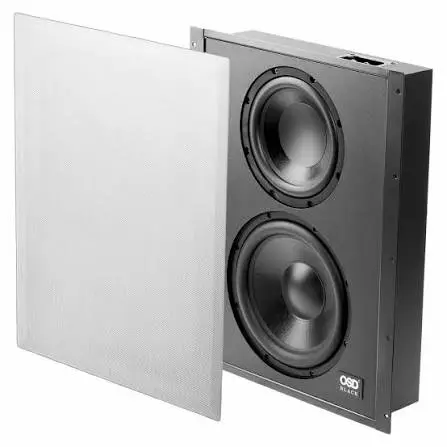
Two Active Front Subs + Two Passive Rear Subs
Option 2:
One Large Front Active Sub + Two Passive Rear Subs
This may look unconventional. But acoustically, it is highly effective. And in many rooms, it performs better than people expect. The idea is simple. The front subwoofers create the main low-frequency energy. The rear passive subwoofers act as supporting bass reinforcement. Their purpose is not to overpower. Their purpose is to balance. This approach gives:
- Better bass coverage
- More headroom
- Less boominess
- Better seat-to-seat consistency
- Better value for money
Why One Big Front Sub + Two Passive Rear Subs Works So Well
This is one of my favorite budget-conscious designs. Many clients cannot justify buying two premium active subwoofers. So instead, I recommend:
- One larger high-output active subwoofer at the front
- Two passive subwoofers at the back
This works beautifully.
Why?
Because bass distribution matters more than simply adding power. A single large sub can provide excellent depth and impact. The rear passive subs help smooth out the room response.
This improves:
- Bass uniformity
- Low-frequency layering
- Tactile feel
- Room balance
And because the rear subs run at much lower power, they don’t require huge amplification. This keeps costs controlled.
The Rear Passive Sub Philosophy
This is where people often misunderstand the concept. The rear passive subs are not “main subs.” They are support subs. Their output should typically remain:20% to 30% of the front active subwoofer output.
The logic is rooted in balancing energy density. The front active unit provides the primary
“anchor” for the bass impact. By adding passive subwoofers at the rear, you are not
necessarily trying to double the raw power; rather, you are adding headroom and
smoothing the low-frequency response across the room. These rear units fill in the gaps
left by the front unit, effectively canceling out localized “booms” and providing a uniform,
enveloping tactile experience for everyone in the room.
Why This is Budget-Friendly
High-end, active subwoofers are expensive because they require high-output drivers,
sophisticated internal DSP, and powerful internal amplifiers. By utilizing passive
subwoofers—such as those offered by OSD or custom solutions using drivers from
Dayton Audio or JL Audio—we can achieve the same structural goal for a fraction of the
cost. You can then drive these rear units using professional-grade external amplification
from brands like Emotiva ,Yamaha, LabGruppen, or Crown. This setup allows you to leverage the
sophisticated pre-out processing of your existing high-end AV Receiver while using
robust, reliable pro-grade power.
The Secret Sauce: Precise Calibration
This solution is not “plug and play.” Its success depends entirely on the accuracy of your
calibration. In a well-tuned hybrid array, the rear subwoofers are generally running at a
significantly lower gain—often just 20% to 30% of the output level of the front powered
subwoofer(s). Their job is not to compete with the front stage, but to support and
reinforce it. By accounting for phase, distance, and output levels, you can achieve a bass
response that is tighter, deeper, and more evenly distributed than any single- or double-
active subwoofer setup could hope to achieve in the same space.
Conclusion: Redefining Value
As professionals in this industry, our duty is to deliver the absolute best experience for our clients. A hybrid multi-subwoofer array is not just a budget workaround; it is a superior acoustic strategy. It allows us to provide professional-grade, invisible, and deeply immersive low-frequency performance that respects the client’s budget while delivering a cinematic experience that is truly world-class.
At AV Consultants, we specialize in transforming residential spaces into high-performance private cinemas. Whether you are looking for a bespoke home theater installation in Chandigarh, Panchkula, or Mohali, or seeking expert acoustic engineering across North India and the NCR region, our team is dedicated to precision calibration and engineering excellence.
Ready to experience the next level of immersive sound?
Visit Us: AV Consultants Plot no 62, Sector 82, JLPL Industrial Area, Mohali