
Klipsch RP-1600SW vs SVS PB-3000: Which Subwoofer Delivers the Ultimate Home Cinema Bass?

When it comes to high-performance home cinema, bass isn’t just something you hear—it’s an intense, physical sensation you feel in your chest. From the thunderous shockwave of an on-screen explosion to the low-frequency atmospheric hum of a sci-fi thriller, a world-class subwoofer breathes life into movie soundtracks by faithfully reproducing the lowest audio octaves.
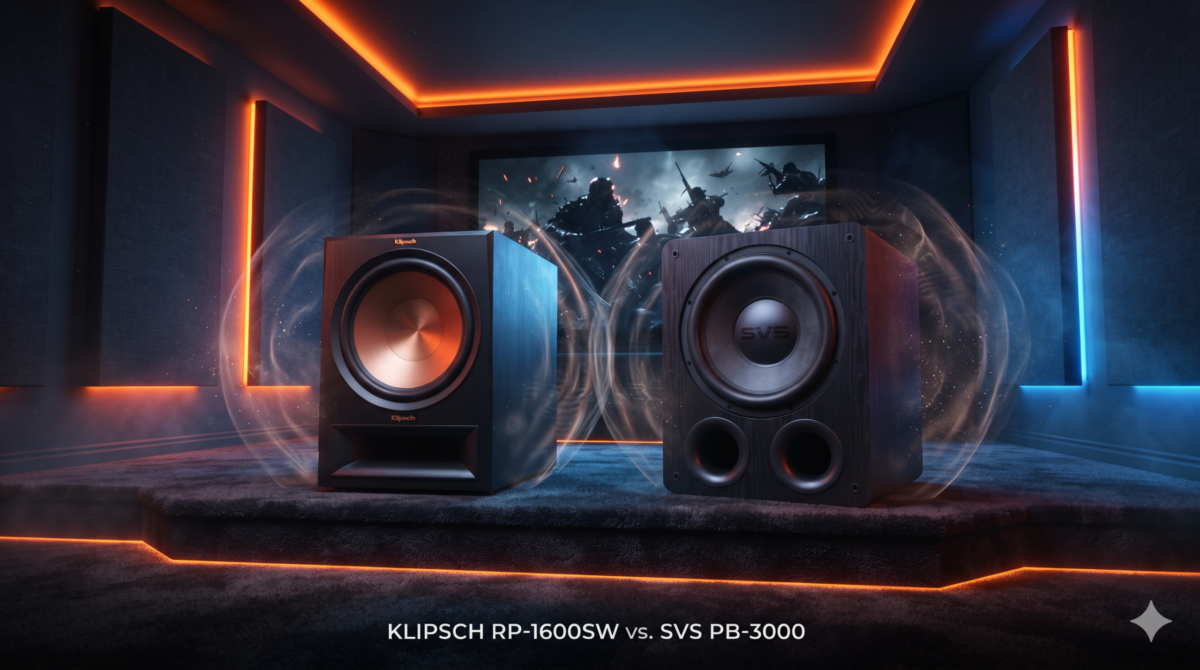
If you are shopping for a serious, high-output home theater upgrade, two ported heavyweights frequently top the shortlist: the Klipsch RP-1600SW and the SVS PB-3000. Both feature robust 800-watt RMS amplifiers and ported cabinet designs engineered for maximum low-frequency extension. However, their contrasting driver sizes, control interfaces, acoustic footprints, and engineering philosophies make them tailored for different types of spaces and users.
At AV Consultants, we know that choosing the right low-frequency powerhouse involves far more than scanning manufacturer spec sheets. Room dimensions, seating placement, room modes, acoustic treatments, and professional calibration play an enormous role in determining how a subwoofer performs in the real world.
Let’s break down how these two titans compare across key performance metrics to help you decide which one belongs in your home cinema.
1. Technical Overview: At a Glance
| Feature / Specification | Klipsch RP-1600SW | SVS PB-3000 |
| Driver Size | 16-inch Cerametallic woofer | 13-inch high-excursion driver |
| Amplification | 800W RMS (Peak power varies) | 800W RMS (Peak power varies) |
| Enclosure Type | Ported (Front-firing Aerofoil slot port) | Ported (Dual front ports with tuning options) |
| Published Frequency Response | Down to 14.5Hz | Down to 16Hz (Standard mode) |
| Control & DSP | Straightforward rear-panel controls | Advanced DSP with smartphone app control |
While these specifications give us a starting baseline, they don’t tell the whole story. Maximum clean output levels, harmonic distortion thresholds, thermal compression, and real-world in-room response ultimately dictate how these subwoofers handle demanding movie tracks.
The Klipsch RP-1600SW specifies a frequency response extending down to 14.5Hz, while the SVS PB-3000 specifies 16Hz in standard mode.
| Parameter | Klipsch RP-1600SW | SVS PB-3000 |
|---|---|---|
| Published lower frequency limit | 14.5Hz | 16Hz |
| Ported enclosure | Yes | Yes |
| Low-frequency movie effects | Excellent potential | Excellent potential |
| Infrasonic performance | Strong on paper | Strong on paper |
2. Driver Size: The Advantage of a 16-Inch Cone
One of the most defining differences between these models is sheer surface area.
- The Klipsch RP-1600SW utilizes a massive 16-inch Cerametallic driver designed to displace large volumes of air effortlessly. Assuming comparable geometry, a 16-inch circular driver possesses roughly 51% more nominal cone area than a 13-inch driver.
- The SVS PB-3000 relies on a smaller 13-inch high-excursion driver tightly integrated with advanced digital signal processing (DSP) and cabinet design.
Why Cone Area Matters
Moving deep bass requires shifting air. A larger driver can potentially achieve high sound pressure levels (SPL) at ultra-low frequencies with less mechanical cone excursion, which helps maintain composure during heavy cinematic transients like earthquakes or depth-charge impacts.
However, cone size isn’t the sole metric of success. Motor strength, suspension elasticity, cabinet volume, port tuning, and amplifier capability work together to shape performance. The SVS PB-3000 proves that smaller engineering footprints can punch well above their weight when backed by smart acoustic design.
3. Deep Bass Extension & Cinematic Impact
Movie soundtracks are packed with demanding low-frequency effects (LFE) that test the limits of audio gear.
- The Klipsch RP-1600SW boasts a published frequency response stretching down to 14.5Hz.
- The SVS PB-3000 is specified down to 16Hz in its standard operating mode.
On paper, the Klipsch digs slightly deeper into infrasonic territory. However, raw specifications don’t guarantee performance in every room. Two subwoofers might both play a 20Hz tone, but one may maintain significantly lower distortion and higher output compression thresholds before running out of headroom. For movie enthusiasts who crave physical chest-slam and tactile immersion, both models deliver elite-tier capability—provided they are paired with a room that can handle them.
4. Ported Enclosure Design & Airflow Management
Both subwoofers use ported enclosures, which utilize a tuned internal volume and vent opening to reinforce low-frequency output around the tuning frequency.
- Klipsch incorporates a front-firing Aerofoil slot port engineered to optimize high-velocity airflow while minimizing turbulence and port chuffing noise.
- SVS features a robust dual-port arrangement on the PB-3000, offering adjustable operating modes and port-tuning flexibility to match room preferences.
Ported designs excel at maximizing output in the lower registers, making them natural favorites for home theater fans. That said, getting the best out of a ported cabinet requires understanding how low frequencies behave inside your specific listening environment.
5. SVS PB-3000: The Power of DSP and App Control
If user-customization and setup convenience are high on your priority list, the SVS PB-3000 holds a distinct edge through its sophisticated DSP platform and Bluetooth smartphone app.
- App-Based Control: Adjust volume, phase, crossover filters, parametric EQs, and room-gain compensation directly from your listening position without fiddling with rear-panel knobs.
- Port Tuning Flexibility: Tailor the subwoofer’s response profile to fit sealed or ported preferences based on your acoustic goals.
While app controls and digital equalization are powerful tools for taming minor response bumps, remember that DSP cannot completely fix deep acoustic nulls (cancellations) caused by room dimensions. Proper physical placement remains essential.
The Klipsch RP-1600SW, by contrast, takes a more traditional, straightforward analog control approach—appealing to purists who prefer a set-it-and-forget-it hardware setup.
6. Room Acoustics: The Hidden Factor in Subwoofer Performance
At AV Consultants, we frequently remind our clients that the room is the most important component in your audio chain. Even a world-class subwoofer can sound boomy, uneven, or anemic if placed incorrectly in a poorly treated space.
Low-frequency sound waves interact heavily with room boundaries, creating standing waves (room modes). This can result in massive bass peaks at certain seats and complete disappearances (cancellations) at others.
When planning a high-end home cinema setup, consider:
- Room dimensions (length, width, and ceiling height)
- Subwoofer distance from walls and corners
- Seating positions relative to pressure zones
- The potential benefits of deploying dual subwoofers to smooth out seat-to-seat response variations
7. Pricing & Market Reality in India
When mapping out a high-end home theater budget in India, imported heavy-hitting subwoofers carry pricing structures shaped by customs duties, freight, authorized national distribution, and GST (typically 18%).
Current retail pricing across authorized Indian dealers and AV integration channels generally spans:
- Klipsch RP-1600SW: Typically retails between ₹2,20,000 to ₹2,30,000 (MRP variants can stretch higher depending on promotional bundles and regional dealer stocking).
- SVS PB-3000: Typically retails between ₹2,69,000 to ₹3,28,500 (depending on standard or newer iterations, authorized dealer margins, and shipping logistics).
8. Which Subwoofer Should You Choose?
Choose the Klipsch RP-1600SW if:
- You prefer the visceral authority and air-moving capacity of a 16-inch driver.
- You want an uncompromised, high-output home theater design tailored for massive physical impact.
- You have adequate physical space in your room for a larger cabinet footprint.
- You prefer traditional, straightforward hardware controls.
Choose the SVS PB-3000 if:
- You prefer a slightly more compact cabinet footprint without sacrificing deep extension.
- You value smartphone app control, parametric EQ adjustments, and flexible tuning options.
- You enjoy fine-tuning your bass response profile directly from your primary seating position.
At AV Consultants, my preference is the Klipsch RP-1600SW, and there is a clear reason behind this decision: in home cinema, bigger can matter when it comes to moving air and delivering physical bass impact..
In my experience working with home cinema clients across North India, space is often less of a limitation than it can be in compact urban homes elsewhere. Many clients have dedicated cinema rooms, spacious basements, or large entertainment areas where a substantial subwoofer can be accommodated without compromising the interior design.
This gives us an opportunity to priorities performance rather than choosing a smaller subwoofer simply to save space.
8. Why Professional Calibration Makes All the Difference
Purchasing a premier subwoofer is only half the battle. Integrating it seamlessly with your AV receiver, main speakers, crossover filters, and acoustic environment requires precision.
An improperly calibrated subwoofer can easily overpower delicate dialogue or leave critical movie moments sounding bloated and disjointed. Achieving a smooth, cohesive blend where the subwoofer disappears into the soundstage requires professional measurement tools, time-alignment, phase matching, and room correction software.
Transform Your Home Theater Experience with AV Consultants
At AV Consultants, located in the heart of Mohali, Punjab, we specialize in high-end home cinema design, acoustic treatment, precision equipment integration, and professional calibration. Whether you are building a dedicated multi-row private theater or optimizing a high-end media room, we help you select and tune the right gear for your unique space.
- Website: avconsultants.in
- Location: Sector 82, JLPL Industrial Area, Mohali
Looking to bring ultimate cinema bass into your home? Contact AV Consultants today for expert guidance on subwoofer selection, acoustic design, and professional system calibration.