

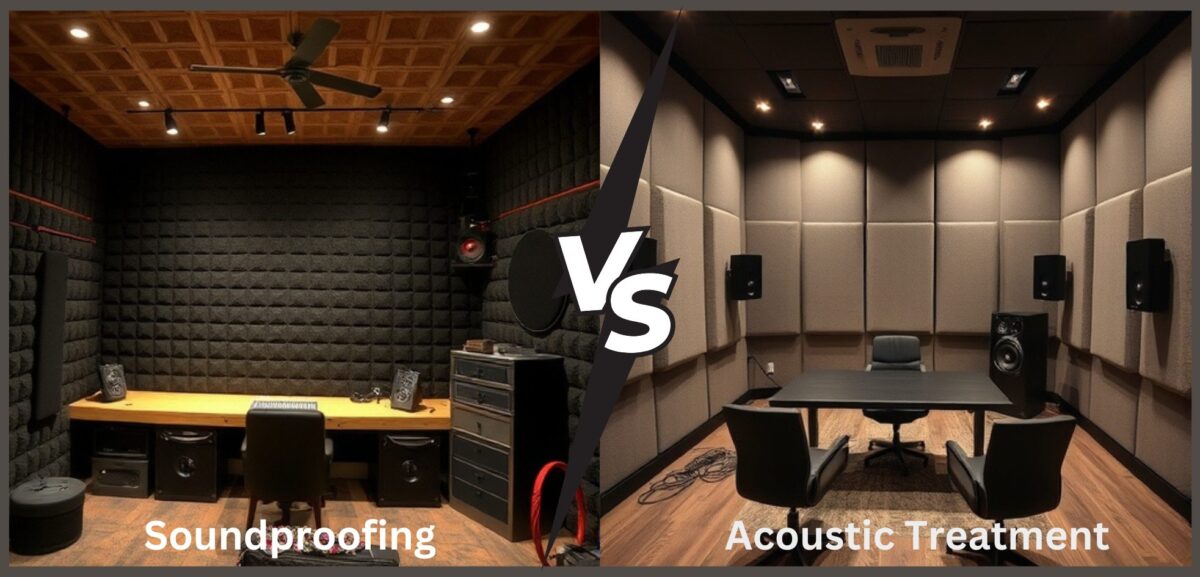
Acoustic Treatment vs Soundproofing: The Real Difference in Home Cinema (Complete 2026 Guide)

With over 17 years of experience in designing high-performance AV spaces, the philosophy at AV Consultants is clear: a great home cinema is engineered through acoustics, isolation, and precision calibration—not just built with products.
In today’s home cinema environment, many people assume that acoustic panels = soundproof room.
That’s simply not true.
Both terms serve completely different purposes, and understanding this difference is critical for designing a high-performance cinema space.
In today’s rapidly growing home cinema market in India, one of the most searched and misunderstood topics is acoustic treatment vs soundproofing. Studio owners & Homeowners investing in premium audio systems often assume that installing acoustic panels will make their room soundproof, or that expensive speakers alone can deliver cinematic sound. However, as emphasized by industry expert as a AV Consultant, true home theater performance comes from a holistic engineering approach—not just equipment.
When discussing home theater acoustics in India, it is crucial to understand that acoustic treatment and soundproofing serve entirely different purposes. Acoustic treatment focuses on improving sound quality inside the room, while soundproofing is about blocking sound transmission between spaces. This distinction is essential for anyone searching for terms like “how to improve home theater sound quality,” “soundproof home cinema room,” or “acoustic panels vs soundproofing.”
Acoustic treatment is the science of controlling how sound waves behave within an enclosed environment. When high-quality speakers from brands like KEF ,focal , B&W , Golen ear , Klipsch , JBL synthesis , Perlisten ,Pylon or Bose produce sound, those sound waves reflect off walls, ceilings, and floors. Without proper treatment, these reflections create echo, reverberation, dialogue loss, and uneven bass—common issues that reduce the overall cinematic experience. This is why searches like “reduce echo in home theater” or “improve dialogue clarity home cinema” are increasingly popular.
📊 Clear Comparison
| Aspect | Acoustic Treatment | Soundproofing |
|---|---|---|
| Focus | Inside the room | Outside/inside isolation |
| Goal | Better sound quality | Noise control |
| Materials | Soft, absorbent | Dense, heavy |
| Installation | Panel-based | Construction-based |
| Cost | Moderate | High |
| Impact | Improves listening | Prevents disturbance |
However, it is important to address a major misconception frequently seen in searches like “do acoustic panels soundproof a room”. The answer is no. Acoustic panels are designed to absorb reflections, not block sound. Because they are soft and porous, they cannot stop sound transmission—especially low-frequency bass, which easily passes through walls. True soundproofing requires dense, airtight construction and is significantly more complex and expensive.
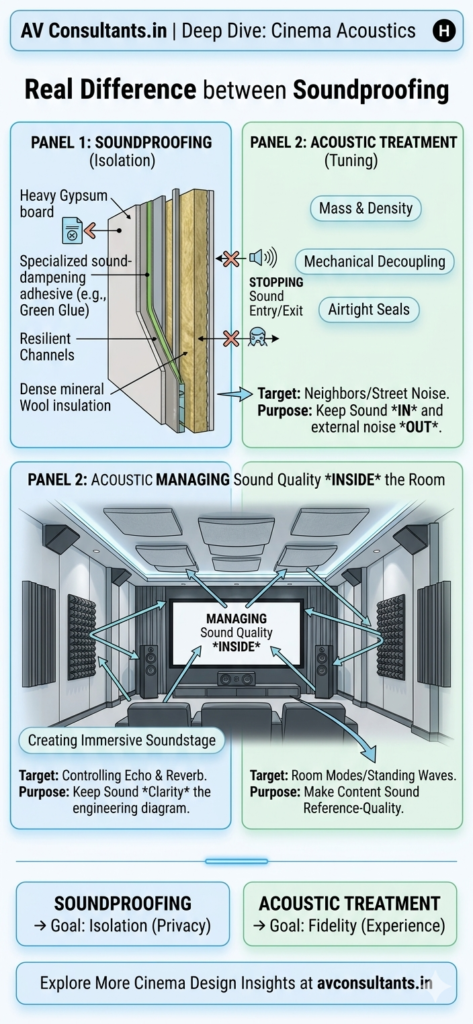
This detailed guide will help you clearly understand:
- What acoustic treatment actually does
- What soundproofing really means
- Why both are important—but not interchangeable
- How to apply the right solution in your home cinema
Understanding the Core Difference
Before going deep, let’s simplify:
- Acoustic Treatment improves sound inside the room
- Soundproofing controls sound entering or leaving the room
That’s the fundamental difference—and everything else builds on this.
What is Acoustic Treatment in Home Cinema?
Acoustic treatment is the process of controlling how sound behaves within a room. When your speakers produce sound, it doesn’t just travel directly to your ears—it reflects off walls, ceilings, floors, and furniture.
These reflections can cause:
- Echo
- Sound smearing
- Dialogue loss
- Uneven bass
🎯 Goal of Acoustic Treatment
To create a balanced, clear, and immersive listening experience
Why Acoustic Treatment is Critical
Even the best speakers cannot perform well in a poorly treated room.
Imagine installing a high-end 7.4.2 system:
- Without treatment → Sound feels harsh, muddy, and uncontrolled
- With treatment → Sound becomes precise, cinematic, and immersive
At AV Consultants, we often tell clients:
“Your room is as important as your speakers.”
Types of Acoustic Treatment Materials
1. Absorption Panels
- Made from rockwool, glass wool, or polyester
- Reduce reflections and echo
- Installed on walls and ceilings
2. Bass Traps
- Placed in corners
- Control low-frequency buildup
- Essential for subwoofer performance
3. Diffusers
- Scatter sound instead of absorbing
- Maintain natural ambience
- Used in rear walls or large rooms
4. Fabric-Wrapped Panels
- Combine performance with aesthetics
- Common in premium home cinemas
🎬 Benefits of Acoustic Treatment
- Crystal-clear dialogue
- Accurate surround sound imaging
- Balanced frequency response
- Reduced listening fatigue
- Professional cinema-like experience
What is Soundproofing?
Soundproofing, also known as sound isolation, is about preventing sound from traveling between spaces.
This includes:
- Stopping sound from leaving your home theater
- Blocking external noise from entering
🎯 Goal of Soundproofing
To contain or isolate sound, not improve its quality
⚙️ How Soundproofing Works
Soundproofing is based on three key principles:
1. Mass
Heavy materials block sound better
- Concrete walls
- Double drywall
2. Sealing
Sound escapes through gaps
- Doors, windows, ventilation leaks
3. Decoupling
Separating structures to reduce vibration transfer
- Floating walls
- Isolated ceilings
🏗️ Common Soundproofing Techniques
- Double wall construction
- Acoustic doors with rubber sealing
- Double or triple-glazed windows
- Floating floors
- Isolation clips and channels
⚠️ Reality Check: Soundproofing is Complex
Unlike acoustic treatment:
- It requires structural planning
- It is expensive
- It must be done during construction stage
At AV Consultants, we always clarify:
“There is no such thing as 100% soundproofing—only sound isolation to a certain degree.”
The engineering comparison between acoustic treatment and soundproofing can be summarized simply: acoustic treatment enhances sound clarity within the room, while soundproofing controls sound volume between rooms. One improves the listening experience; the other manages noise control. Both are important, but they are not interchangeable.
The Biggest Myth in Home Cinema
❌ “Acoustic panels will make my room soundproof”
This is the most common misunderstanding.
Why it’s wrong:
- Acoustic panels are soft and porous
- Soundproofing requires dense and heavy materials
👉 Foam panels, polyester boards, and fabric panels:
- Improve sound quality
- Do NOT stop sound from escaping
Even thick panels cannot block bass frequencies.
In conclusion, understanding the difference between acoustic treatment and soundproofing is critical for building a high-performance home cinema. Investing in the right acoustic design will deliver far greater returns than simply upgrading equipment. As emphasized by AV Consultants, the goal is not just louder sound—but better, more accurate, and immersive sound. By applying the correct balance of acoustic treatment and sound isolation, homeowners can achieve a true cinematic experience tailored to their space, budget, and expectations.
Understanding the difference between acoustic treatment and soundproofing is essential for building a true home cinema experience.
- If your goal is immersive, high-quality sound → Acoustic Treatment is mandatory
- If your goal is noise isolation → Soundproofing is optional but strategic
At AV Consultants, every project is designed with a holistic engineering mindset, ensuring that:
- Technology performs at its best
- Acoustics are scientifically optimized
- Clients experience true cinematic immersion