


Expert Analysis by Deepak Saxena – AV Consultants Mohali
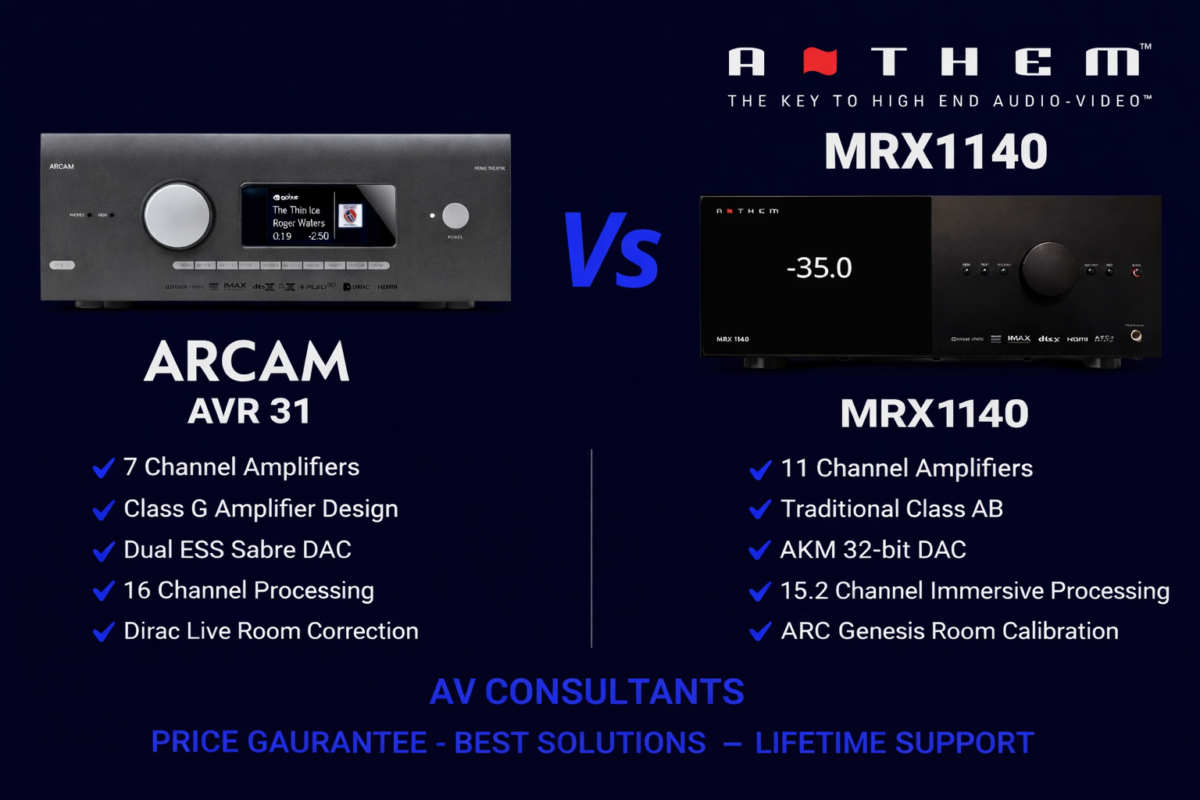
When comparing premium AV receivers like the Arcam AVR31 and the Anthem MRX 1140, it is important to look beyond basic specifications. True performance depends on DAC architecture, amplifier topology, HDMI bandwidth, DSP processing capability, and room correction technology.When evaluating premium AV receivers for a high-end Dolby Atmos home theatre, the internal hardware architecture plays a crucial role in determining overall performance, sound quality, and system scalability. The Arcam AVR31 and the Anthem MRX 1140 are both positioned in the reference category of AV receivers, but their hardware design philosophies are quite different.
The Arcam AVR31 is built with a strong audiophile focus, featuring a sophisticated Class-G amplifier topology that dynamically switches power rails to deliver higher efficiency, reduced distortion, and greater dynamic headroom compared to traditional Class-AB designs. This receiver includes seven channels of internal amplification supported by a high-current power supply and a robust chassis that helps minimize electrical noise and vibration. In addition, Arcam integrates dual ESS Sabre ES9026PRO DAC chips, which are widely used in high-end digital audio components due to their exceptional dynamic range and extremely low noise floor. This hardware architecture makes the AVR31 particularly strong for music playback, stereo imaging, and high-resolution audio reproduction, especially when paired with external power amplifiers for larger Atmos systems.
On the other hand, the Anthem MRX 1140 is engineered primarily with cinema performance and multi-channel scalability in mind. It incorporates eleven channels of built-in Class-AB amplification along with a powerful DSP processing platform capable of handling up to 15.2 channels of immersive audio decoding. The hardware design emphasizes flexibility and ease of installation, allowing installers to configure speaker layouts such as 7.2.4 Dolby Atmos without the need for additional amplifiers. Anthem utilizes the AKM AK4458VN 32-bit DAC platform, which is optimized for stable multi-channel audio processing and accurate surround sound reproduction. The MRX 1140 also features a strong internal power supply and a reliable amplifier matrix that distributes power efficiently across multiple channels during demanding movie soundtracks. While it may not focus as heavily on audiophile stereo refinement as the Arcam unit, its hardware platform is extremely effective for delivering powerful cinematic dynamics and immersive surround sound in larger home theatre environments.
Complete Specifications Comparison
| Specification | Arcam AVR31 | Anthem MRX 1140 |
|---|---|---|
| Receiver Category | Premium Audiophile AV Receiver | Premium Cinema AV Receiver |
| Amplifier Channels | 7 built-in channels | 11 built-in channels |
| Processing Capability | 16 channels | 15.2 channels |
| Amplifier Design | Class-G Amplification | Class-AB Amplification |
| Power Output | 120W/ch (8Ω, 2ch driven) | 140W/ch (first 5 channels) |
| Remaining Channels Power | 100W (7 channels driven) | ~60W per channel |
| DAC Architecture | Dual ESS Sabre ES9026PRO | AKM AK4458VN 32-bit DAC |
| Supported Formats | Dolby Atmos, DTS:X, Auro-3D | Dolby Atmos, DTS:X |
| Room Correction | Dirac Live | ARC Genesis |
| HDMI Inputs | 7 | 7 |
| HDMI Outputs | 3 | 3 |
| HDMI Version | HDMI 2.1 | HDMI 2.1 (upgradeable) |
| Video Support | 8K/60, 4K/120 | 8K capable |
| HDR Formats | HDR10, HDR10+, Dolby Vision, HLG | HDR10, Dolby Vision |
| Subwoofer Outputs | 2 | 2 independent |
| Streaming | AirPlay2, Chromecast, Roon Ready, MQA | AirPlay2, Chromecast, Spotify |
| Bluetooth | aptX HD | Bluetooth 4.2 |
| Network | Ethernet / Wi-Fi | Ethernet / Wi-Fi |
| Pre-outs | 16 channel | 15.2 channel |
| Dimensions | 433 × 425 × 171 mm | 432 × 364 × 153 mm |
| Weight | 18.1 kg | 15.2 kg |
| Power Consumption | up to 1500W | ~570W typical |
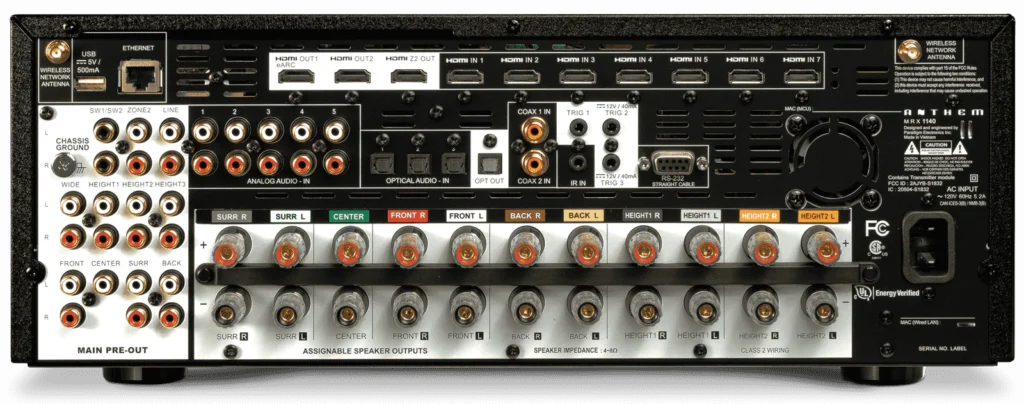
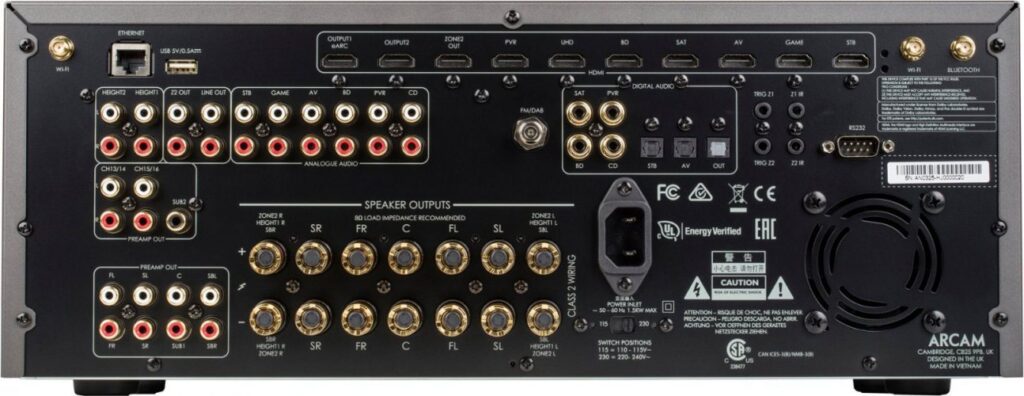
From a connectivity perspective, both receivers feature modern HDMI 2.1 hardware supporting 8K video pass-through, 4K/120 gaming signals, and enhanced audio return channel (eARC). Each model includes seven HDMI inputs and three HDMI outputs, making them compatible with advanced video sources such as next-generation gaming consoles, streaming devices, and high-performance projectors. In addition, both receivers provide extensive pre-amp outputs for external amplification, network connectivity for streaming services, and control integration for custom home automation systems. However, the Arcam AVR31 tends to be favored in systems where sound purity and music performance are a priority, while the Anthem MRX 1140 is often selected for installations where higher numbers of powered channels and simpler system integration are required.
From the perspective of professional home theatre design at AV Consultants Mohali, led by Deepak Saxena, both receivers represent excellent engineering but cater to slightly different installation goals. The Arcam AVR31 stands out for its premium DAC architecture and unique Class-G amplifier technology, making it ideal for audiophile-grade cinema rooms where music playback quality is equally important as movie performance. In contrast, the Anthem MRX 1140 offers a powerful all-in-one hardware solution with more built-in amplification channels, making it a practical choice for large Dolby Atmos home theatres that require robust multi-channel power without relying heavily on external amplifiers.
Sound Performance Overview
Arcam AVR31 Sound Character
The AVR31 is known for:
• Warm and natural midrange
• Exceptional stereo imaging
• Excellent musical detail
• Smooth high frequencies
This makes it an ideal AVR for users who prioritize both music and movies.
Rich Musicality + Immersive Sound = Stunning Realism
Anthem MRX 1140 Sound Character
The MRX 1140 focuses on cinema dynamics and surround immersion.
Strengths include:
• Powerful bass impact
• Strong surround steering
• Excellent dialogue clarity
• Great performance for action movies


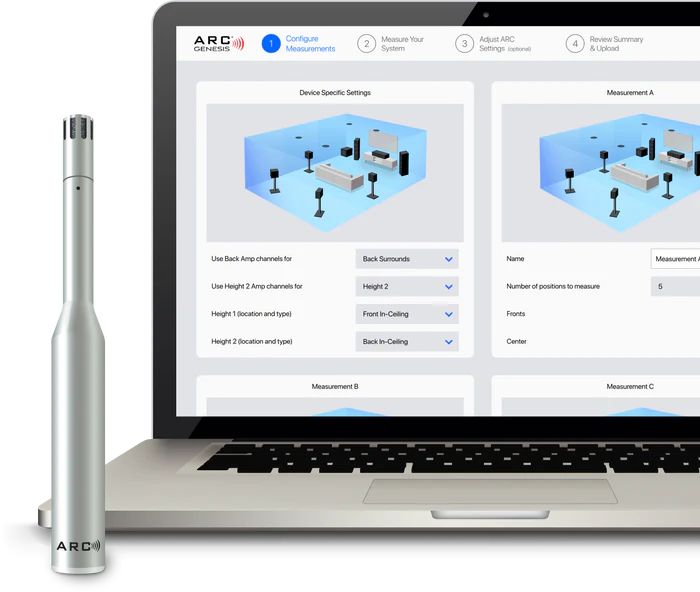
Anthem using NEW! ARC Genesis Software
ARC Genesis is the newest software that works with many ARC enabled Anthem or Paradigm product. New features include support for both Mac and Windows; new target curve adjustment options including deep bass and high frequencies; improved algorithms and much more.
ARC Genesis is backwards compatible with many Anthem and Paradigm products that are ARC or PBK enabled. For a complete list, please visit AnthemARC.com. This third generation of Anthem Room Correction software represents a significant leap forward in room correction with the most comprehensive set of features yet. ARC Genesis transforms the audio performance of compatible speakers or electronics while retaining the unique character of any room. Proprietary Digital Signal Processing (DSP) software works in tandem with a calibrated microphone (provided with many ARC and PBK enabled products) to provide astonishing improvements to the sound you hear.
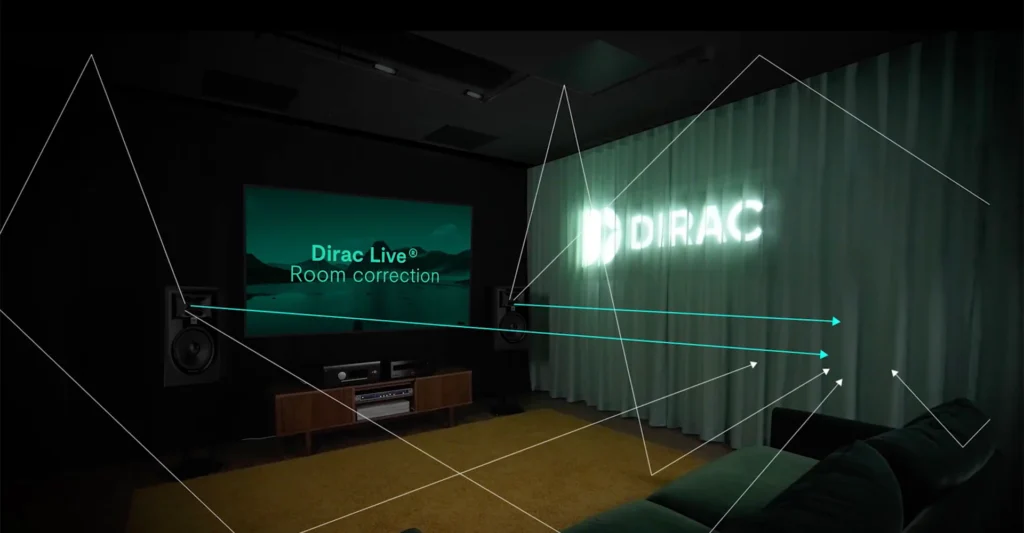
Arcam Dirac Live calibration optimizes sound by measuring room acoustics with a microphone, correcting frequency/impulse responses to enhance performance. It requires a PC/Mac, the Dirac Live software, and the included USB mic (with calibration file). The process involves connecting the Arcam unit to the network, measuring 9+ positions (starting at the main listening spot), adjusting volume levels, and exporting the calculated filters to the receiver.Dirac Live® Technology
Dirac Live® is a mixed-phase room correction technology used in cinemas, studios and luxury cars. It
corrects not only the frequency response but also the impulse response, a factor critical for accurate
staging, clarity and bass reproduction.
Dirac Live® will:
High-resolution filters through a proprietary filter structure with low computational requirements.
Improve the imaging of your sound system and the clarity of the music
Make voices more intelligible
Produce a tighter bass
Reduce listening fatigue
Improve the timbre, remove resonances and room modes
Reduce early reflections
Mixed-phase filtering for maximum performance and time domain control
Final Professional Recommendation
For audiophile home theatres, the Arcam AVR31 offers superior DAC performance and advanced Dirac calibration.For large Dolby Atmos cinema setups, the Anthem MRX 1140 provides more internal amplification and simpler installation.Both receivers are excellent choices depending on system design goals and speaker configuration
Hardware Verdict.
From a hardware engineering perspective, the two receivers serve slightly different purposes.
Arcam AVR31 hardware strengths
 audiophile Class-G amplification
superior DAC architecture
better music performance
Anthem MRX 1140 hardware strengths
more internal amplifiers
flexible Atmos speaker layouts
strong cinema performance
For luxury home theatre installations, the ideal configuration often uses:
Arcam AVR31 as processor + external power amplifiers.while the Anthem MRX 1140 remains one of the best all-in-one cinema receivers available.Both receivers are excellent, but they target different types of home theatre systems.
Choose Arcam AVR31 if:
- Music quality is your priority
- You plan to use external power amplifiers
- You want Dirac Live room correction
Choose Anthem MRX 1140 if:
You prefer simpler setup and calibration
You want more built-in amplifier channels ,Your system is primarily for movies and Dolby Atmos
As per my recommendation AVR 31 is better choice with adding power amplifiers for better sound stage . Price on Arcam is higher side but you get excellent audio bandwidth.
Anther MRX1140 is value for money with 15 channel amplification. But when you uses full amplification it gives lesser power to all channels that is big drawback of this hi end AVR.