

By Deepak Saxena – Founder, AV Consultants
Introduction: The Most Misunderstood Component in Home Cinema
In the world of high-end home cinema, nothing is more misunderstood—and more underestimated—than the subwoofer.
Most clients believe that bass is simply about loudness. They assume that buying a bigger or more powerful subwoofer will automatically deliver a cinematic experience. But in reality, bass performance is governed not by equipment alone, but by acoustic physics, room interaction, and system design.
Bass takes massive energy to produce. A single 12-inch/15 inch subwoofer might have to push to its absolute mechanical limit to achieve a reference-level 115DB transient. This causes distortion and port noise.
While low bass frequencies are technically omnidirectional, distortion and sympathetic vibrations from a single powerful sub can sometimes make it “localizable.” Your ears can pick up that the boom is coming from the left corner.
This is where the difference between a standard home setup and a professionally engineered cinema becomes evident.
At AV Consultants, we often encounter clients who have invested in premium speakers, powerful AV processors, and even high-end projectors—yet their system lacks impact, depth, and realism. The root cause is almost always the same:
An improperly designed low-frequency system—typically relying on a single subwoofer.
This article explores, in depth, why one subwoofer is not sufficient, why two is the minimum standard, and why four subwoofers represent the benchmark for luxury, reference-grade home cinema.
The Physics of Bass and Why it’s Challenging in Home Environments
To understand why multiple subwoofers are superior, we need to consider the physics of low-frequency sound waves. Bass waves are incredibly long and powerful, making them significantly harder to control than mid-range and high-frequency waves.
When a subwoofer produces bass, it emits long sound waves that interact heavily with the room’s boundaries—walls, floor, and ceiling. These interactions create a phenomenon known as standing waves, or more formally, Room Modes.
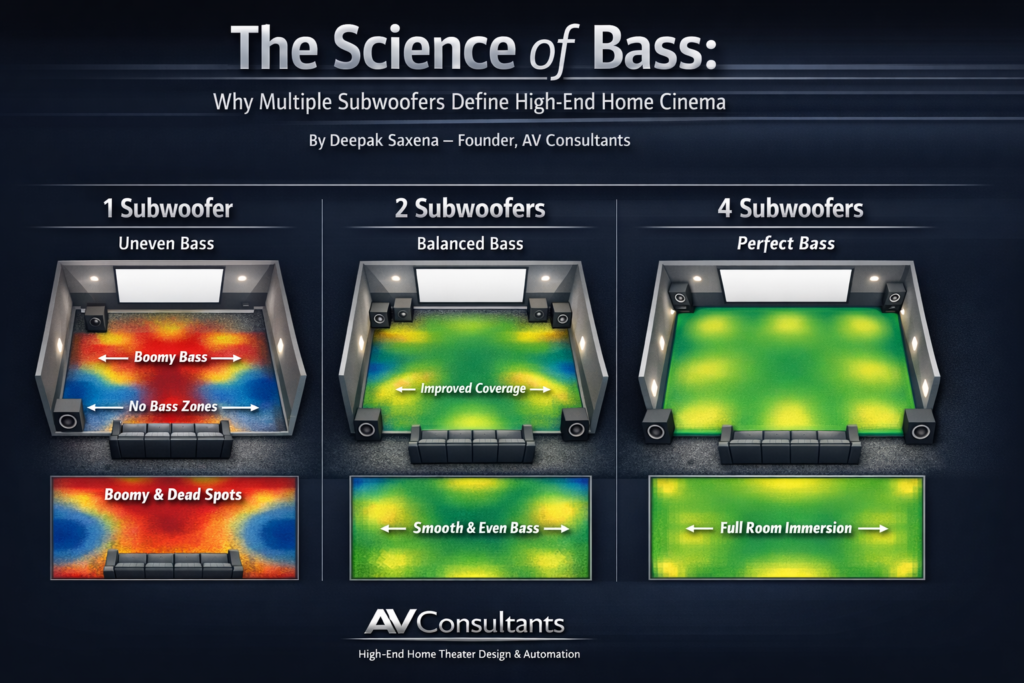
What Happens Inside Your Room?
When bass waves reflect and overlap, they create:
- Peaks – Areas where bass is exaggerated and boomy
- Nulls – Areas where bass almost disappears
- Phase issues – Bass feels disconnected or delayed
This means:
👉 Two people sitting just a few feet apart can experience completely different bass performance.
No matter how expensive your subwoofer is, a single source cannot overcome these physical limitations.
The Myth of “One Powerful Subwoofer”
One of the biggest misconceptions in home cinema is:
“If I buy a very powerful subwoofer, I don’t need more than one.”
This is fundamentally flawed.
A single subwoofer:
- Excites room modes unevenly
- Creates strong peaks and deep nulls
- Cannot distribute bass evenly across multiple seats
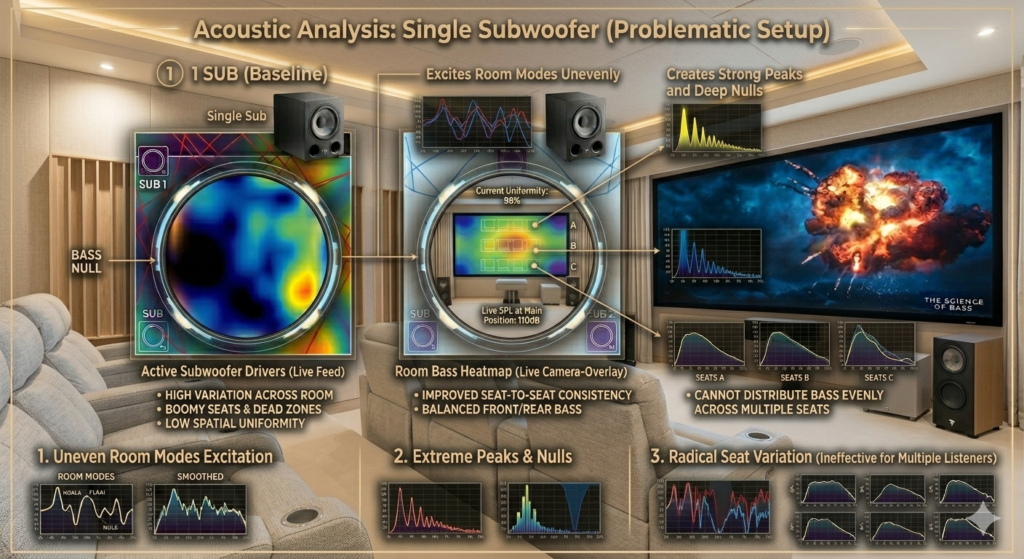
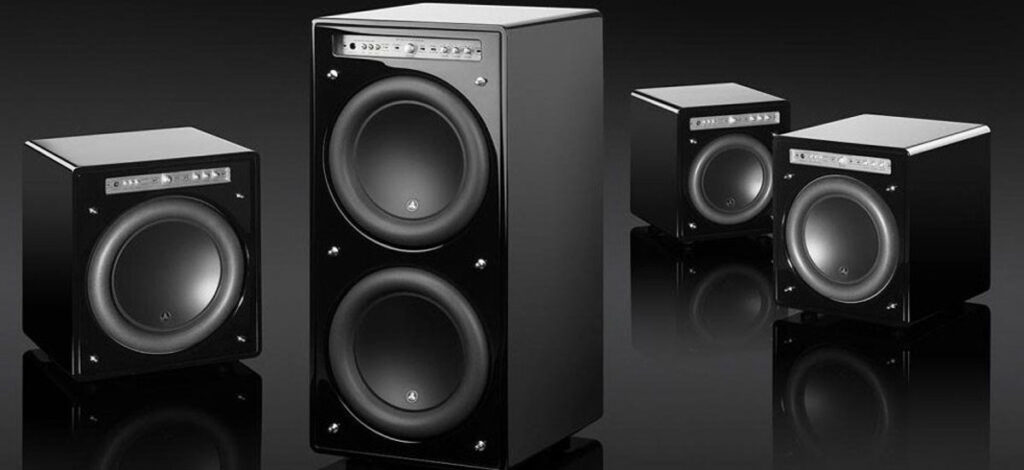
Even ultra-premium models from brands like SVS, JL Audio, REL ,Klipsch or KEF will struggle if used alone in a typical room.
The issue is not power—it is distribution.
Why Dual Subwoofers Are the Minimum Standard
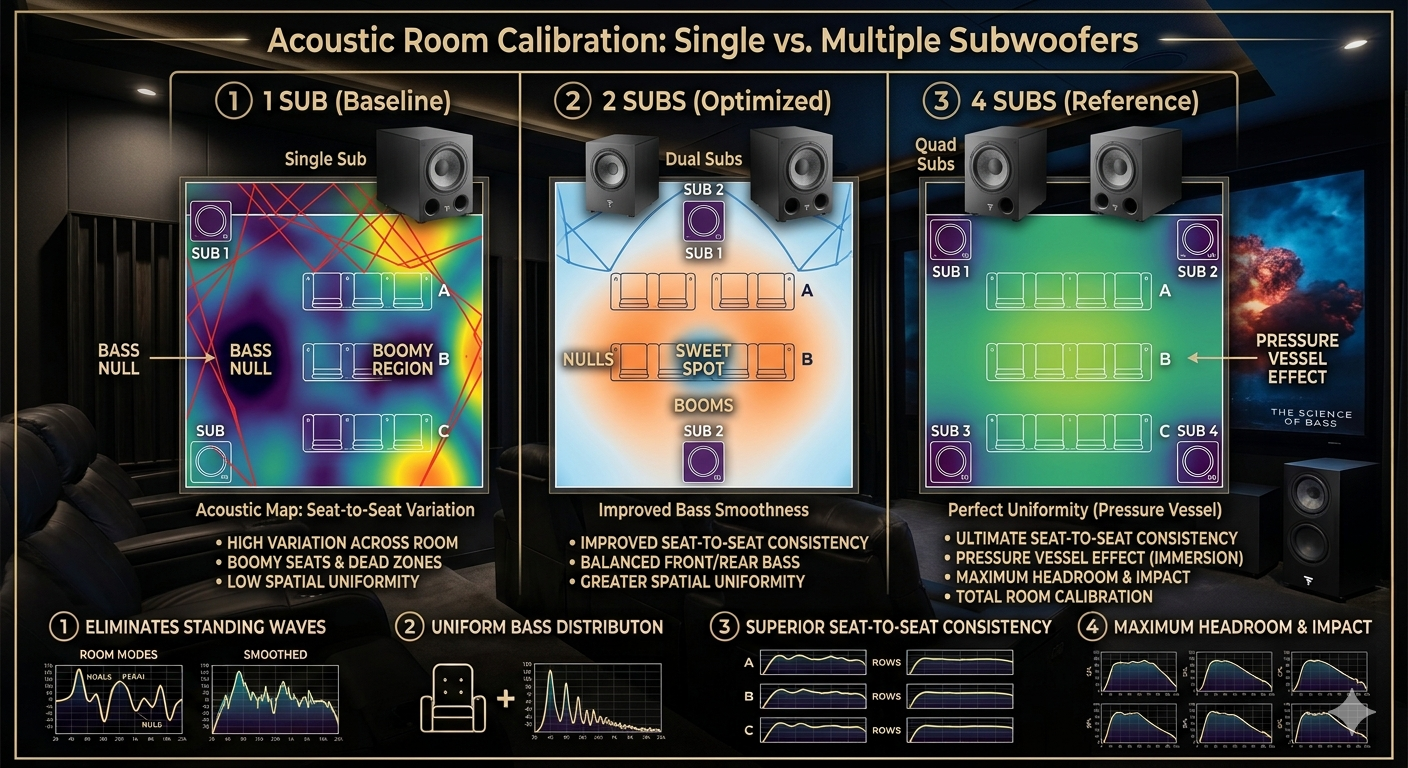
The introduction of a second subwoofer transforms the system from a single-point bass source into a distributed low-frequency system.
Moving from one to two subwoofers is arguably the biggest leap in performance-per-dollar. It drastically improves bass smoothness and consistency, dramatically reducing localization. This makes the bass feel more integrated and non-directional, while also providing increased output and dynamic headroom. For many high-end home cinemas, a pair of well-integrated subwoofers represents the ideal balance of performance, practicality, and cost.
This is why industry leaders like Dolby Laboratories and THX strongly recommend dual subwoofer configurations.
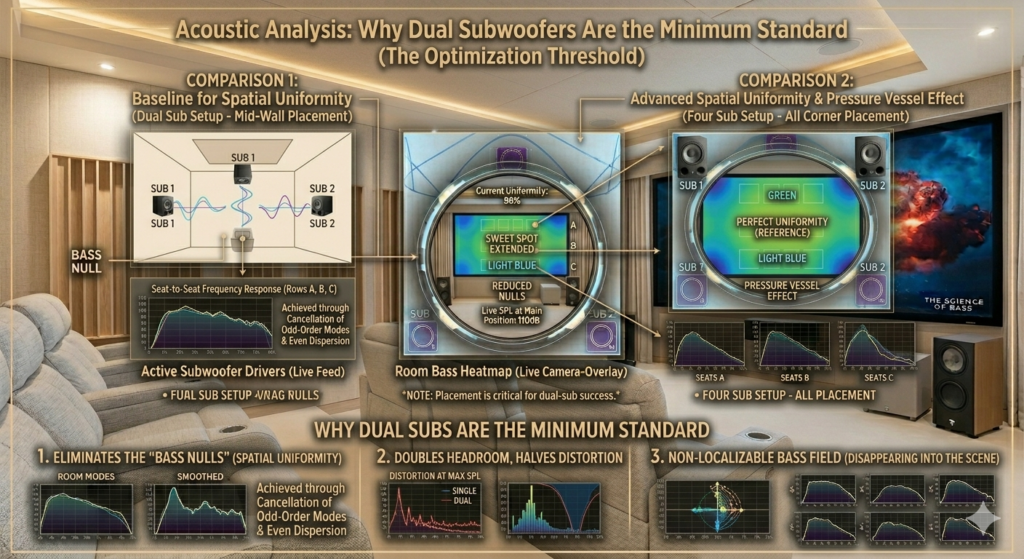
What Changes with Two Subwoofers?
In high-performance cinema design, the move from a single transducer to a multi-subwoofer array is as much about thermal management and linear excursion as it is about volume.
1. Exponential Gain in Dynamic Headroom
To achieve the THX/Dolby Reference Standard of 115DB for the Low-Frequency Effects (LFE) channel, a single subwoofer is often forced to its mechanical and electrical limits. By integrating a second identical unit, you don’t just add volume; you fundamentally change the system’s stress profile.
- The 6db Advantage: Doubling the number of subwoofers (and doubling the amplifier power) yields a theoretical +6db increase in Maximum SPL (Sound Pressure Level).
- Operating Efficiency: Because decibels are logarithmic, this +6db”safety net” means that to reach the same target volume, each individual subwoofer now only requires 50% of the original power.
2. Drastic Reduction in Total Harmonic Distortion (THD)
When a single driver is pushed to its maximum “throw” (excursion), it enters a non-linear state where the magnetic field and suspension (spider/surround) lose control. This results in audible Total Harmonic Distortion (THD) and power compression.
- Linear Operating Range: By sharing the workload, multiple subwoofers stay within their linear operating window.
- Eliminating Mechanical Noise: This prevents “port chuffing” (air turbulence noise) and mechanical strain. The result is a transient response that is significantly “tighter”—bass starts and stops with surgical precision, providing the “punch” without the “hangover” of muddy, lingering resonance.
When properly placed and calibrated, dual subwoofers:
- Reduce the severity of room modes
- Fill in bass nulls
- Improve consistency across seating positions
- Deliver tighter and more controlled bass
Real-World Impact
Instead of:
- One seat having too much bass
- Another seat having none
You get:
- Balanced, immersive bass across the room
This is the minimum requirement for serious home cinema.
The Leap to Four Subwoofers: True Cinema Performance
While dual subwoofers improve performance significantly, they still cannot completely eliminate room-induced inconsistencies.
This is where four subwoofers come in.
A four-subwoofer system is based on advanced acoustic strategies such as:
- Distributed Bass Array
- Wave Interference
What Four Subwoofers Achieve
Four Subwoofers (The Pinnacle of Immersion and Performance):
For large, dedicated home theaters with multi-row seating, or for those aiming for the absolute pinnacle of performance, four subwoofers are often the recommendation of leading AV consultants. Why?
- Total Room Calibration: While two subs are excellent, four subs provide even finer control over room interactions. Advanced calibration techniques can minimize bass variations throughout the entire room, not just across a single row of seats. This ensures everyone in the theater, regardless of their position, experiences the same level of impactful and accurate bass.
- Maximum Headroom and Impact: Four subwoofers offer incredibly high output capability with minimal distortion. This level of power ensures effortless delivery of the most demanding low-frequency effects in modern blockbuster movies, creating a truly immersive and visceral experience.
- Optimal Control: Large rooms with multi-row seating present unique acoustic challenges that are difficult to overcome with only two subwoofers. Four subs placed strategically (often in all four corners or mid-wall positions) provide the necessary flexibility and control to manage complex standing waves and deliver uniformly smooth bass.
- Near-uniform bass throughout the room
- Dramatic reduction in peaks and nulls
- Faster, tighter transient response
- Seamless integration with main speakers
- Identical experience for every listener
This is the level of performance expected in luxury private cinemas and reference studios.
| Number of Subs | Primary Benefit | Best For |
| 1 Sub | Impact & Low Cost | Single-seat listening. |
| 2 Subs | Smoother response & Seat-to-seat consistency | Small to medium dedicated rooms. |
| 4 Subs | Total room calibration & Maximum headroom | Large theaters with multiple rows of seating. |
Four Subwoofers: Frequently placed in each of the four corners or centrally on all four walls. This “double bass array” (DBA) or multi-sub configuration effectively averages out the room modes.
Example:-Case Study: The Van Cave (A 13.7.8 Masterclass) for multiple Subwoofer array
The Configuration: Why Seven Subwoofers?
While we’ve argued for the necessity of four subwoofers, the Van Cave takes it further to achieve Total Infrasonic Immersion. The system is split into two specialized groups to handle the full spectrum of human feeling:

- The Impact Layer (5x JBL Synthesis SSW-1): * These are dual 15-inch “behemoths” positioned to handle the LFE (Low Frequency Effects). They provide the “kick” and “slam” that makes action movies feel real.
- The Infrasonic Layer (2x Ascendo 24-inch Subs): * Equipped with 24-inch drivers and dedicated 6,000W amplifiers, these handle frequencies below 20Hz. These aren’t heard; they are felt as changes in room pressure.
The Results: 5,000+ Simulations
The team at Paradise Theater didn’t guess where these subs should go. They ran thousands of computer simulations to ensure:
- Near-Zero Variance: The bass response in the front-left seat is identical to the back-right seat.
- The “Vessel” Effect: By using seven subs, they created a “Double Bass Array” that cancels out reflections, meaning the bass never “booms”—it simply hits and disappears.
The “Pressure Vessel” stats
| Component | Specification |
| Total Subwoofer Drivers | 12 individual drivers (10x 15″, 2x 24″) |
| Total Subwoofer Wattage | Approx. 38,000 Watts dedicated to bass |
| Frequency Response | Flat down to well below 10Hz |
| Processor Control | Trinnov-based JBL Synthesis SDP-75 (32-Channels) |
“The Van Cave proves that multiple subwoofers aren’t about being loud—it’s about the precision of air pressure. It’s the difference between hearing an explosion and feeling like you’re standing in one.”
Example Case Study :-MASSIVE KEF 9.10.6 Home Theater Tour America
If the “Van Cave” is the pinnacle of raw power, the KEF America Music Lounge in Marlboro, NJ, is the pinnacle of Acoustic Engineering and Integration. This THX-Certified theater doesn’t just use multiple subwoofers; it uses a staggering ten subwoofers to redefine what “seamless” bass sounds like.
In a 9.10.6 configuration, KEF isn’t just making the room loud; they are solving the most difficult problem in acoustics: Low-Frequency Standing Waves in a Large Volume.
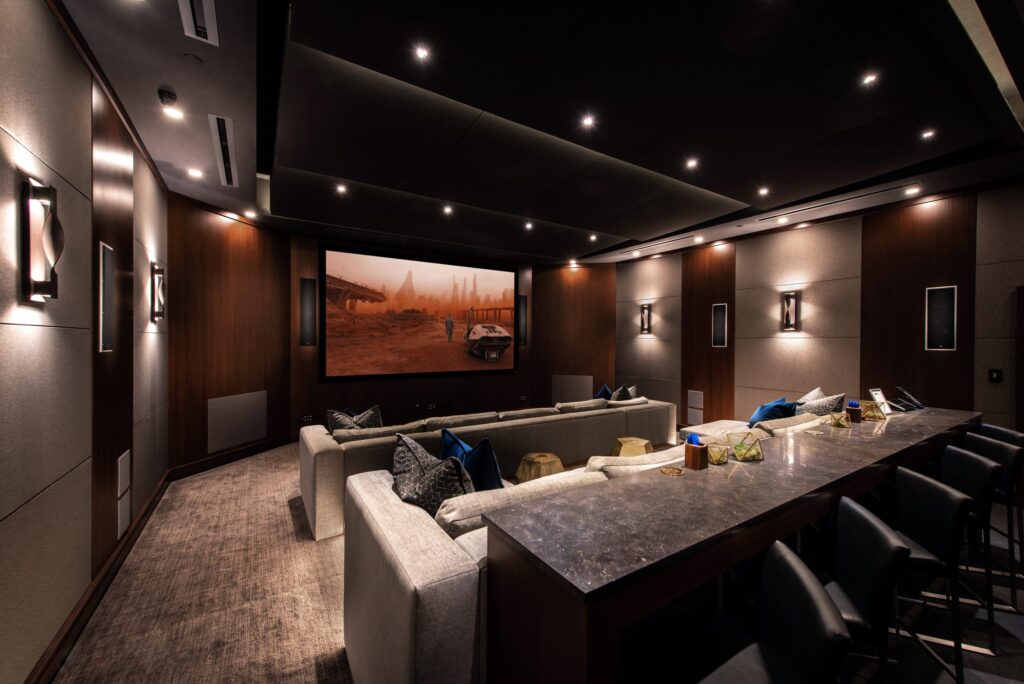
1. Why 10 Subwoofers? (The Scientific Breakdown)
The KEF Music Lounge occupies over 9,500 cubic feet—a massive space that would swallow a single subwoofer whole. By using ten units, KEF achieves three critical goals:
- Modal Smoothing: With 10 sources of bass distributed throughout the room, the subwoofers work together to cancel out each other’s “nulls” and “peaks.” This creates a bass response that is identical in every single seat of the theater.
- The “Force-Cancelling” Advantage: KEF utilizes subwoofers like the KF92 (and the newer KC92), which feature two drivers positioned back-to-back. This “force-cancelling” design ensures that the subwoofer cabinets themselves don’t vibrate, leaving only pure, distorted-free bass energy in the air.
- In-Wall Integration: To maintain the aesthetic of a luxury lounge, many of these are Ci3160RLb-THX in-wall subwoofers. This proves that you don’t need “refrigerator-sized” boxes on the floor to get world-class impact if you have enough discrete sources.
- Effortless impact: Because 10 subwoofers are sharing the load, each one is barely “breathing” even at THX reference levels. This leads to a level of transient speed (how fast the bass starts and stops) that is usually only found in live musical performances.
The Final Lesson
The KEF Music Lounge proves that quantity, when managed by elite DSP, creates quality. By using 10 subwoofers, they have effectively “killed” the room’s negative acoustics, leaving only the artist’s original vision.
Final Verdict: The Architecture of Bass, Not the Equipment
Deepak Saxena, a seasoned expert with over 17 years in the audio-visual industry, firmly believes that achieving reference-grade sound is not a matter of simply investing in expensive hardware—it is an architectural and scientific discipline.
According to Saxena, the role of multiple subwoofers is often misunderstood. They are not added for excess—they are implemented as the only scientifically valid method to neutralize the room itself.
In his words, the objective is not just to hear bass, but to create a calibrated, pressurized acoustic environment where sound behaves predictably, uniformly, and with absolute control.
The AV Consultants Philosophy
At AV Consultants, this philosophy is applied to every project—whether it is a compact media room or a flagship private cinema.
The approach is clear:
- Design the room as an acoustic system
- Use multiple subwoofers to control physics, not fight it
- Calibrate for uniformity, not just output
Because true luxury in home cinema is not defined by how loud it plays—
It is defined by how effortlessly and accurately it performs.
Closing Statement
For Deepak Saxena, the conclusion is definitive:
A single subwoofer plays bass.
A multi-subwoofer system engineers the experience.
And in the world of high-performance home cinema:
Engineering always wins over equipment.