

Deepak Saxena (AV Consultants) Explains the 9.4.6 & 13.6.8 Revolution in Immersive Home Cinema
For nearly two decades, home cinema revolved around a simple formula: 5.1 and 7.1 surround sound. These formats defined the industry—reliable, predictable, and sufficient for most home theater room & living rooms.
In 2026, that era is over.
We are no longer simply designing sound systems—we are engineering true three-dimensional acoustic environments. Yet, a common misconception still persists: many people believe that adding more speakers or channels automatically increases both budget and loudness. In reality, neither assumption fully holds true.
Loudness vs Immersion: The Biggest Myth
One of the most widespread misunderstandings in modern home cinema is the idea that more speakers mean louder sound. As explained by Deepak Saxena of AV Consultants, increasing the number of channels does not increase loudness—it enhances how sound is distributed throughout the room. Loudness is purely a function of sound pressure (SPL), while immersion is the result of precision, spatial accuracy, and uniform coverage.
In high-channel systems such as 9.4.6 and beyond, sound is not amplified through fewer speakers—it is intelligently distributed across many. This reduces the workload on each speaker, minimizes distortion, and ensures consistent performance across every seat in the room, not just a single sweet spot. The outcome is not higher volume, but a far more refined and realistic listening experience.
With this approach, listeners begin to perceive the subtle layers of sound that define true cinematic realism—delicate echoes, air movement, and natural decay. This level of reproduction leads to what professionals call audio transparency, where the system effectively disappears, leaving only the experience.
If you are still planning a 5.1.2 or 7.2.2 system, you are building for yesterday. Today’s high-performance home cinema is driven by a far more advanced concept:
Spatial Resolution
The ability to:
- Feel the movement of air
- Track sound with pinpoint precision
- Experience a seamless 360° sound field
This is the Immersive Audio Frontier—where sound is no longer heard from speakers, but experienced as a living, breathing environment.
From Channels to Objects: The Real Revolution
The most significant transformation in modern audio is the shift from channel-based sound to object-based sound processing. Traditional systems like 5.1 or 7.1 were fundamentally limited because sound was locked to specific speaker positions. A helicopter could only jump from one speaker to another, creating noticeable transitions rather than natural movement.
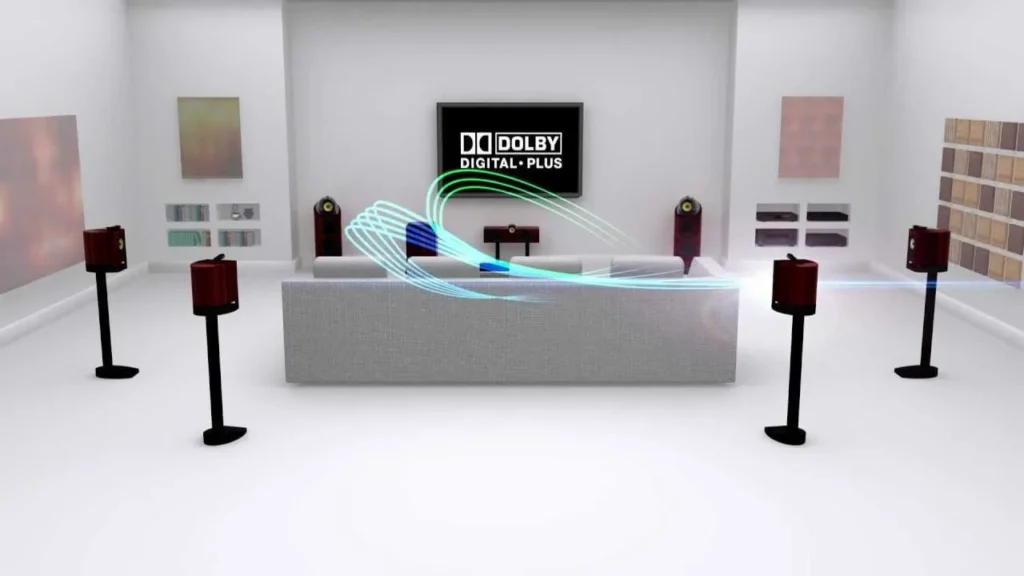
Modern formats such as Dolby Atmos and DTS:X Pro have completely redefined this approach. Instead of assigning sound to fixed channels, they treat each sound as an independent “object” that exists in three-dimensional space. This allows audio to move fluidly around the listener with pinpoint accuracy, regardless of speaker layout.
In practical terms, this means that sound is no longer constrained—it flows. Movement becomes continuous, transitions disappear, and the listening experience becomes cohesive. A car passing through a scene doesn’t jump between speakers; it travels smoothly across the room. Rain doesn’t fall from a point—it envelops the entire space.
According to Deepak Saxena of AV Consultants, this shift is not just technological—it is philosophical. It changes the role of system design from simply placing speakers to engineering spatial continuity. The addition of more speakers, therefore, is not about increasing output—it is about increasing resolution within space. More channels mean more precision, fewer gaps, and a more believable acoustic experience.
If you are still planning a 5.1.2 or 7.2.2 system, you are building for yesterday. Today’s high-performance home cinema is driven by one concept:
1. From Channels to Objects: The Real Revolution
The biggest shift in modern audio is the move from channel-based to object-based sound.
Formats like Dolby Atmos and DTS:X Pro no longer assign sound to fixed speakers.
Instead, they treat sound as objects in 3D space.
Old Approach (5.1 / 7.1):
- Sound locked to specific speakers
- Limited movement
- Audible “jumps” between channels
Modern Approach (9.4.6 / 13.6.8):
- Sound moves freely in space
- No gaps
- Continuous, fluid motion
👉 More speakers = higher spatial accuracy, not just more volume.
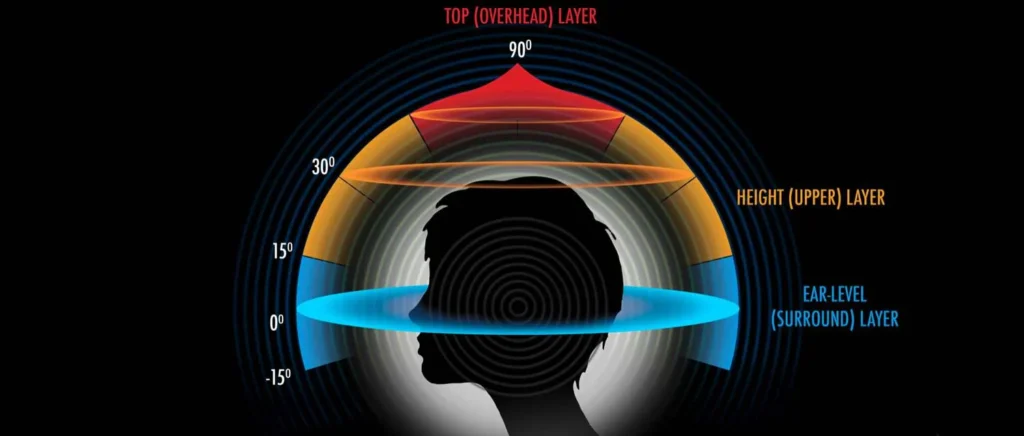
2. Understanding Modern Configurations
9.2.4 — The New Luxury Baseline
The 9.2.4 configuration marks a significant departure from traditional layouts. One of its most critical upgrades is the introduction of front wide speakers, which solve a long-standing issue in home theater design—the gap between front and surround channels.
In older systems, this gap often caused sound to “break” as it moved from the screen to the sides. With front wides, that transition becomes seamless. The soundstage expands horizontally, making the screen feel larger than its physical dimensions. Motion across the front becomes fluid, and the entire front hemisphere gains coherence.
For many high-end residential projects, this configuration is now considered the minimum standard for true immersion.

11.4.4 — Balanced Perfection
When a system evolves to 11.4.4, it begins to feel effortless. This is where engineering meets experience in a balanced way. The most critical upgrade here is not just additional speakers—but the inclusion of four subwoofers.
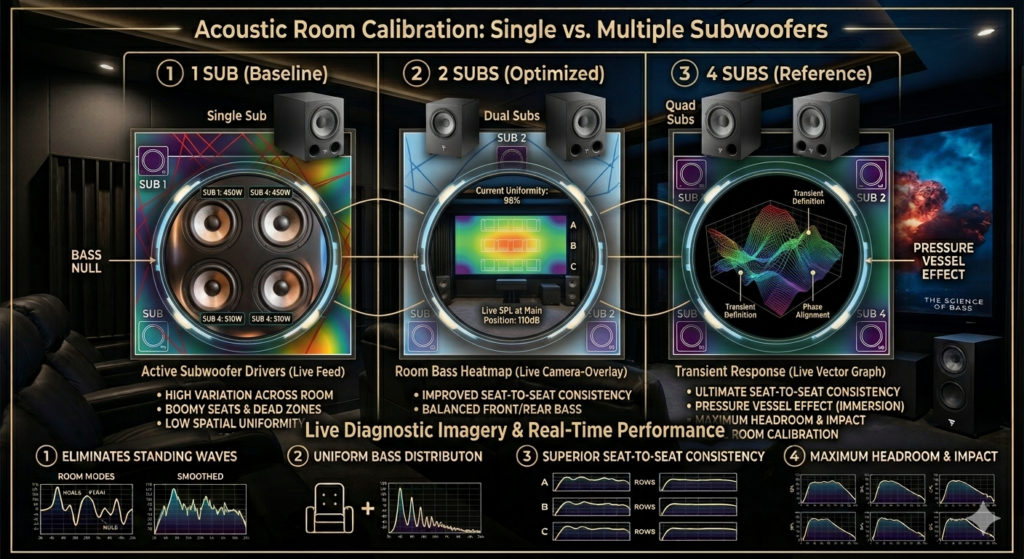
Low-frequency performance is the most challenging aspect of any room. With a single or dual subwoofer, bass is uneven—strong in some areas and weak in others. By moving to four subwoofers, the system begins to normalize the room, eliminating dead zones and boomy corners.
The result is uniform bass distribution across all seating positions. Every listener experiences the same impact, the same depth, and the same control. This is also where the concept of room pressurization begins to emerge—where bass is not just heard but physically felt in a controlled and consistent manner.
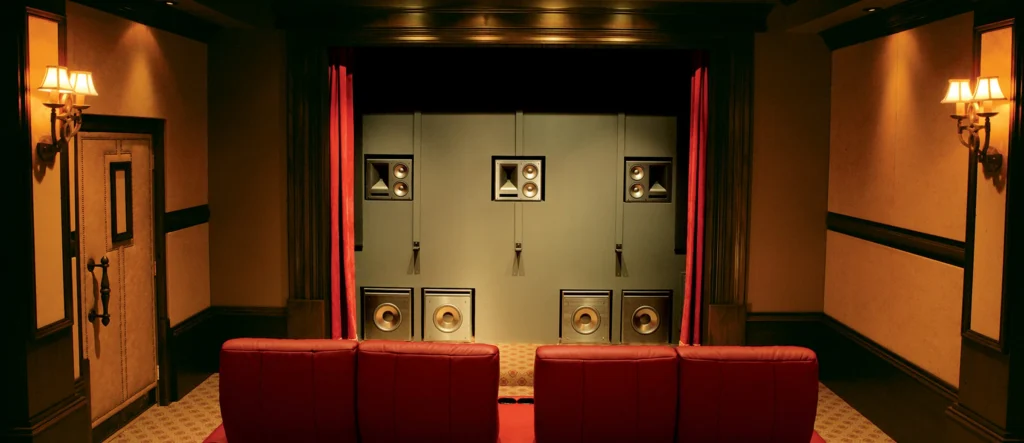
13.6.8 — The Endgame System
This is not just a home theater—it’s an acoustic environment.
At 13.6.8, the system transcends traditional definitions of home theater. This is no longer about watching content—it is about stepping into an environment.
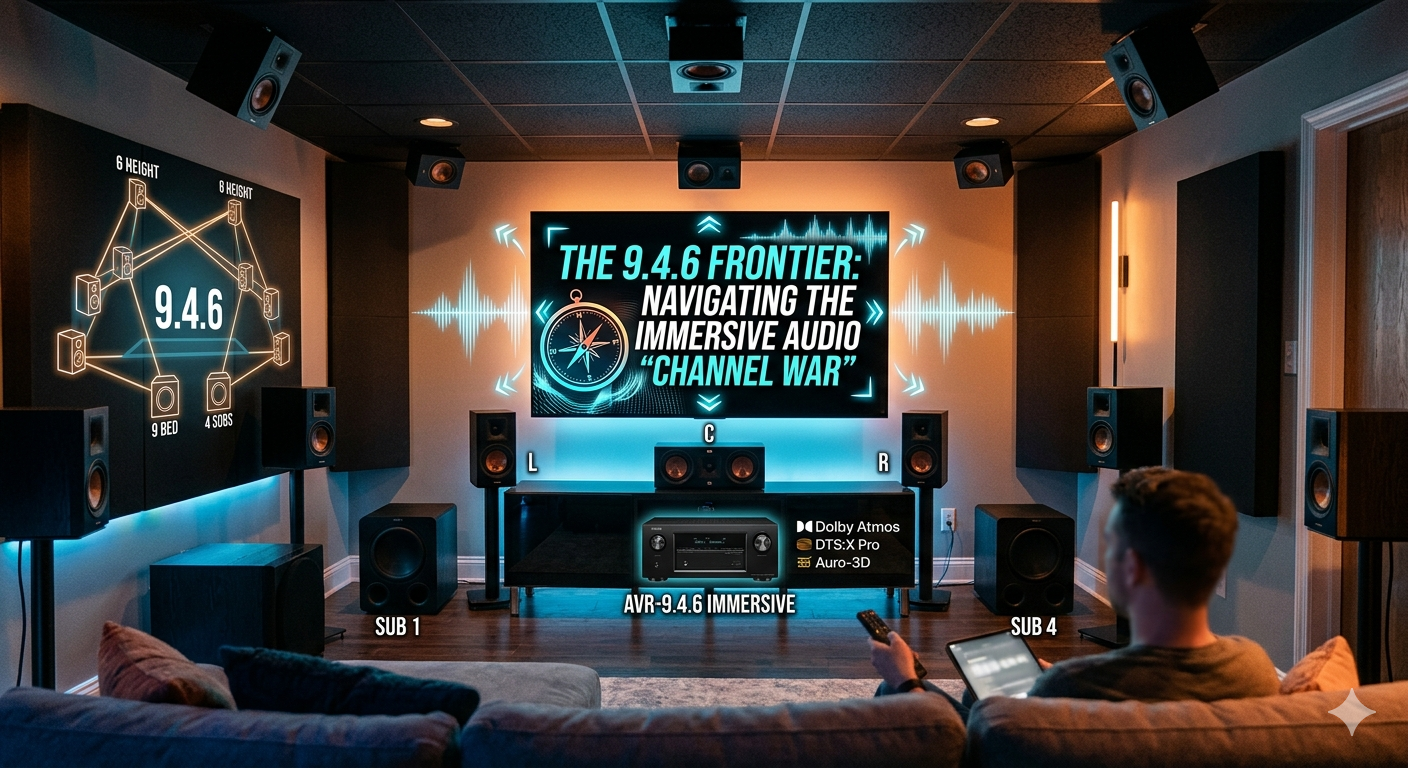
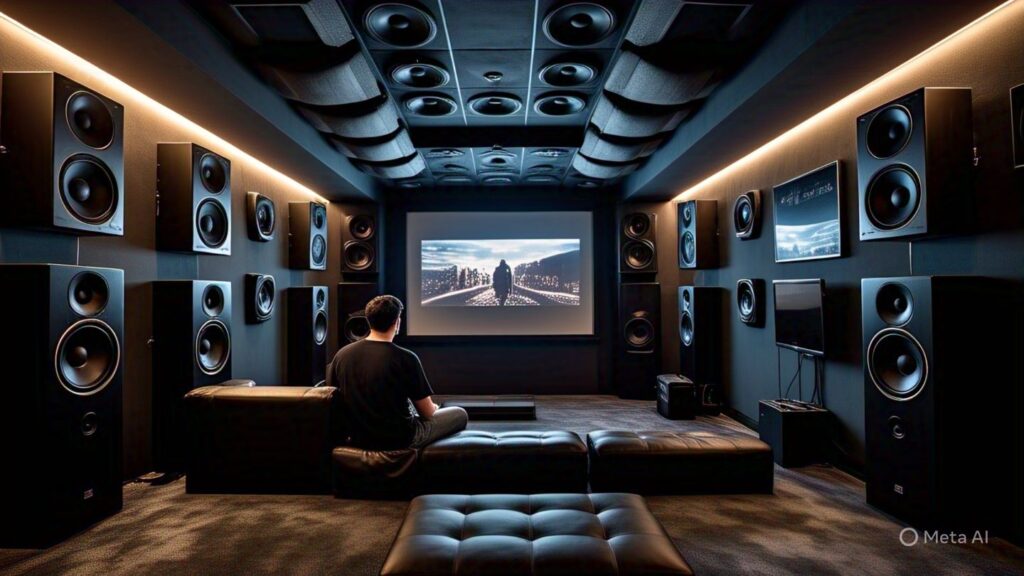
With 13 ear-level speakers, the room achieves complete horizontal coverage. Six subwoofers create a unified bass engine that behaves as a single, controlled system rather than multiple independent sources. Eight height channels introduce a level of vertical realism that transforms overhead effects into physical sensations.
In such systems, rain does not sound like it’s coming from speakers—it feels like it exists above you. Aircraft don’t pass overhead—they travel through space with continuity and scale. Every movement is smooth, invisible, and natural.
This is where the room disappears entirely, leaving only the experience.
3. The Rise of the Bass Engine
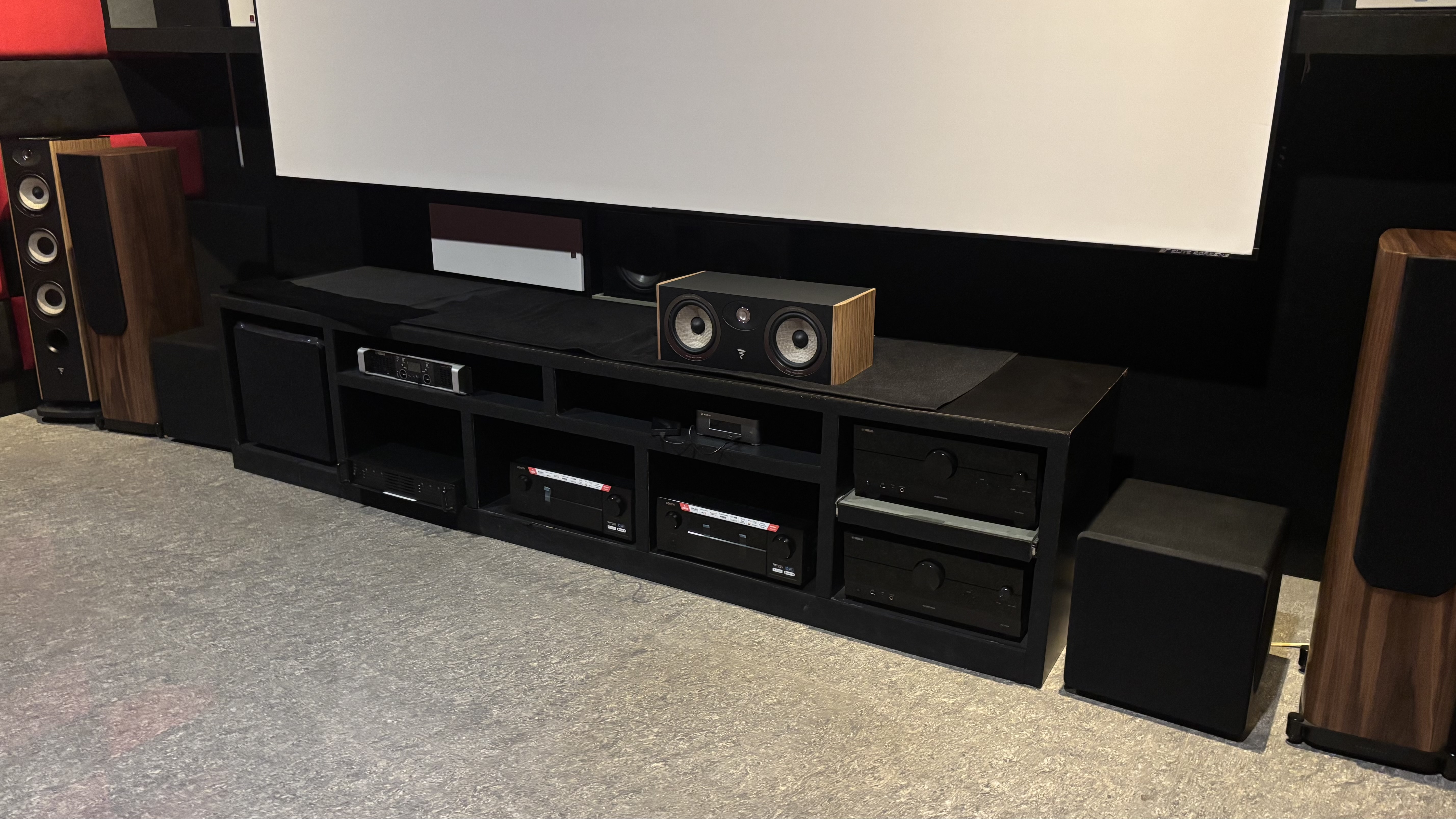
Subwoofers are no longer accessories.
They are now core system architecture.
One of the most important yet misunderstood evolutions in modern home cinema is the transformation of subwoofers from optional components into core system architecture.
In traditional setups, subwoofers were treated as add-ons—used primarily to enhance low-frequency impact. Today, they form what professionals call a bass engine, a fully integrated system designed to control how low frequencies behave within the room.
With dual subwoofers (.2), performance improves primarily at the main seating position. With four (.4), bass becomes consistent across the entire room. As systems move to six or even eight subwoofers, they begin to incorporate advanced techniques such as active bass management, modal control, and reflection mitigation.
This results in bass that is not only powerful but also fast, tight, and highly controlled. It eliminates the common trade-off between impact and precision, delivering both simultaneously.
According to AV Consultants, this is one of the most critical upgrades in high-performance cinema design. Without proper bass architecture, even the most expensive systems fail to deliver true immersion.
What It Takes to Build a 9.4.6+ System
Achieving this level of performance is not about purchasing high-end equipment—it is about system integration at an architectural level. Every component must work in harmony, and every decision must be intentional.
Processing Power
High-channel systems require advanced processors capable of handling large numbers of discrete audio channels with extreme precision. Brands such as Trinnov Audio, StormAudio, Arcam, Marantz, and Anthem are at the forefront of this space, offering processors that can manage anywhere from 11 to over 30 channels.
These processors are not just signal routers—they are computational engines that calculate spatial positioning, timing, and phase relationships in real time.
Acoustic Design
A high-performance system is only as good as the room it operates in. Acoustic design plays a critical role in ensuring that sound behaves predictably and accurately.
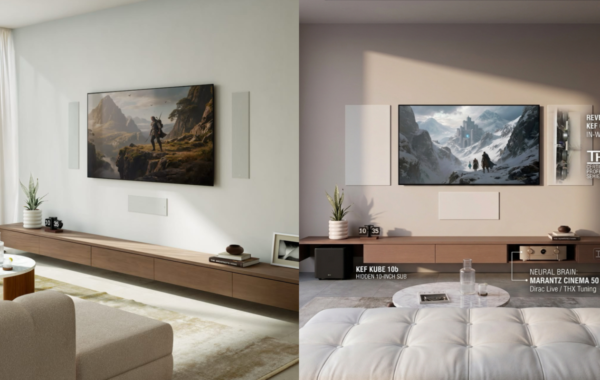
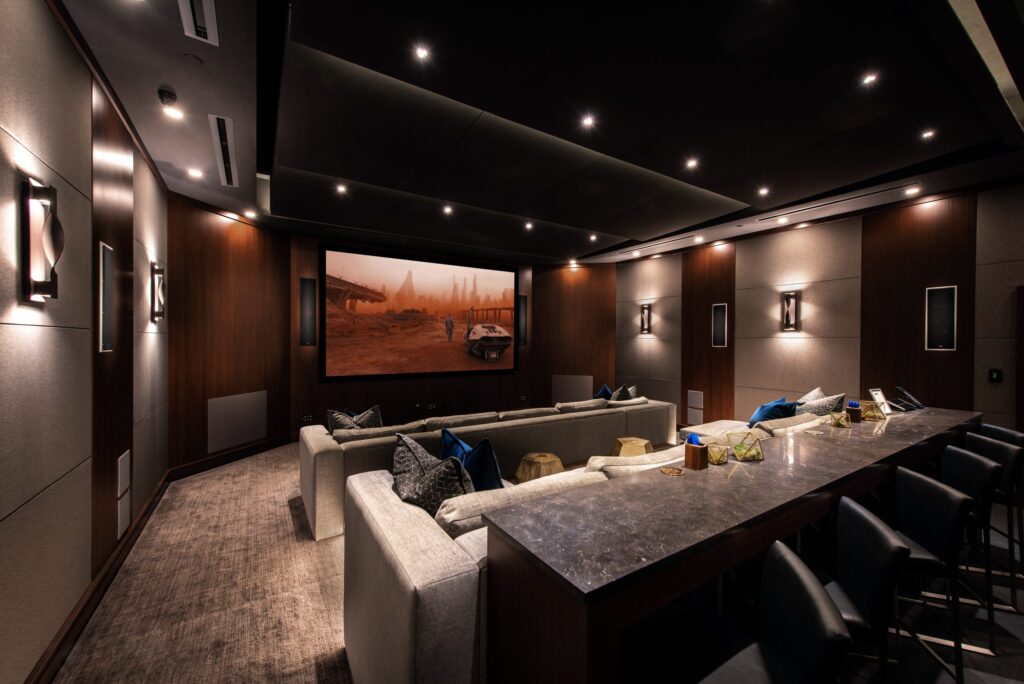
Modern luxury theaters incorporate acoustically transparent screens, allowing speakers to be placed behind the image for perfect alignment. Fabric wall systems conceal speakers while controlling reflections and reverberation. Every surface in the room is treated as part of the acoustic equation.
The ultimate goal is simple:
Hear everything. See nothing.
Calibration and Tuning
Perhaps the most critical step in the entire process is calibration. Modern systems rely on advanced tools and methodologies, including AI-driven room correction, phase alignment, and time-domain optimization.
Each speaker is calibrated with microsecond-level precision to ensure that sound arrives at the listener exactly as intended. This level of tuning transforms a collection of components into a cohesive, high-performance system.
Deepak Saxena and AV Consultants approach calibration as both a science and an art—combining measurement data with critical listening to achieve reference-grade performance.
Conclusion: Experience vs Equipment
The so-called “Channel War” is often misunderstood as a competition between brands or specifications. In reality, it represents a much deeper shift in how we experience sound.
The difference is not between systems—it is between experiences.
A 5.2.2 system allows you to watch a movie.
A 9.4.6 or 13.6.8 system allows you to live inside it.
It is the difference between observing a scene and feeling the environment around you. Between hearing sound and being surrounded by it.
As we move deeper into 2026, the goal is no longer louder systems or bigger specifications. The goal is precision—creating a sound field so accurate, so seamless, that the technology disappears completely.
And when that happens, something remarkable occurs:
You stop noticing the speakers.
You stop noticing the room.
You simply experience the world the story was meant to create.
By Deepak Saxena | Founder – AV Consultants